What does dog epilepsy cost, and will insurance pay?
The cost of epilepsy is spread over years rather than one bill. Here is where it goes, a real UK referral price list for scale, and the insurance rules that catch people out.

Dog epilepsy costs most in the first year, when a diagnosis is made, then settles into ongoing costs for daily medicine, blood tests and check-ups, plus the occasional emergency. A specialist work-up with MRI is the biggest single cost: one UK university referral hospital lists £3,675 for EEG, MRI and spinal fluid tests. Insurance usually covers epilepsy only if the policy started before the first signs, and a lifetime policy is the type that keeps paying for a long-term condition.
- Costs come in three parts: diagnosis (mostly year one), ongoing care (every month), and emergencies (unpredictable).
- An MRI isn’t automatic. Vets usually recommend one when a dog is under 6 months or over 6 years at onset, has an abnormal neurological exam, has clusters or status epilepticus, or doesn’t respond to treatment.
- Insurers treat a condition that showed signs before the policy started as pre-existing, and usually exclude it.
- Lifetime policies keep paying each year you renew; time-limited and maximum-benefit policies run out.
- Never cut or stop seizure medicine to save money: sudden withdrawal can trigger severe seizures.
In this guide
How much does it cost to treat a dog with epilepsy?
There isn’t one number: it depends on your dog’s size, which medicines they need, how often blood tests are done, whether they need specialist tests, and your practice’s prices. What is predictable is the shape of the spending.
For scale: the Association of British Insurers reported an average pet insurance claim of £685 in 2024, across all conditions. Long-term conditions like epilepsy can generate claims every year.
What does diagnosing epilepsy in a dog cost?
After a first seizure, your vet’s job is to rule out other causes, such as poisoning or illness elsewhere in the body, before calling it epilepsy. That usually means an examination and blood tests at your own practice. Some dogs are then referred to a neurologist.
The specialist work-up is the big one-off cost. As a real example, Langford Vets (University of Bristol) lists these neurology prices, correct as at 1 May 2026, including VAT:
| Item | Listed price |
|---|---|
| Referral consultation | £340 |
| Epilepsy clinic investigations: EEG, MRI and spinal fluid (CSF) | £3,675 (£3,938 if blood tests are needed) |
| Seizure cases work-up including consultation, bloods, EEG, MRI, CSF and 24 hours in hospital | £3,675 – £4,500 |
Other hospitals and countries will differ, so ask for an estimate. Many dogs never need this. The International Veterinary Epilepsy Task Force diagnostic proposal recommends MRI and spinal fluid tests mainly when:
- seizures started before 6 months or after 6 years of age
- there are abnormal signs on a neurological exam between seizures
- your dog has had status epilepticus or cluster seizures
- seizures haven’t responded to a properly tried medicine
How much does ongoing epilepsy treatment cost?
Ongoing care is the cost you live with. It usually includes:
- Daily medicine, usually for life. Price depends on the drug and your dog’s weight, so a large dog costs more. Ask your practice what each option would cost per month.
- Blood tests to check drug levels and liver values: more often at the start and after dose changes, then periodically.
- Check-ups and repeat prescriptions.
Our medication guide explains what each drug does and why the blood tests matter.
Never stop, reduce or switch a seizure medicine to save money without your vet. Stopping suddenly can cause severe withdrawal seizures, which are more dangerous, and usually more expensive, than the medicine. If cost is a problem, tell your vet; there may be options.
What emergency costs should I plan for?
Two situations bring the big unplanned bills: a seizure lasting more than 5 minutes (status epilepticus) and cluster seizures (2+ in 24 hours). They can mean an out-of-hours visit, injections and a stay in hospital. Ask your vet what an emergency visit typically costs locally, and where the nearest out-of-hours clinic is, before you need it.
A seizure lasting more than 5 minutes, or seizures one after another without your pet recovering in between, is an emergency. Call your vet or the nearest emergency clinic now and tell them you're on your way. A first-ever seizure also needs a call to your vet the same day, even if your pet seems fine afterwards.
See our guide to clusters and status epilepticus for what to do.
Does pet insurance cover epilepsy?
Usually, if two things are true: the epilepsy started after the policy began, and the policy type keeps paying for a long-term condition.
Pre-existing conditions
Which? defines a pre-existing condition as one that existed before you took out the policy, including during the waiting period at the start. If your dog had a seizure, or was investigated for one, before cover started, epilepsy will usually be excluded. Switching insurer after a diagnosis usually means the new insurer excludes it too.
In the US, the NAIC notes that most pet insurers exclude pre-existing conditions. Its model law adds that a condition already covered under a policy can’t be treated as pre-existing when that policy renews, though not every state has adopted it.
Policy types
| Policy type | How it works (Which?) | For epilepsy |
|---|---|---|
| Lifetime | Pays out for treatment over your pet’s lifetime, subject to annual limits, as long as you renew | Best suited to a lifelong condition |
| Time-limited | Has both a money limit and a time limit, often 12 months from the first claim, after which the condition is excluded | Runs out |
| Maximum benefit | Pays a set amount per condition and stops when it is used up | Can run out over years |
| Accident-only | Covers injuries, not illnesses | Doesn’t cover epilepsy |
Also check the excess (the part you pay on each claim), any co-payment, and the annual limit. Read the policy wording, not just the summary.
How can I make insurance claims easier?
- Keep every invoice and note which condition it was for.
- Claim promptly: policies have deadlines for submitting claims.
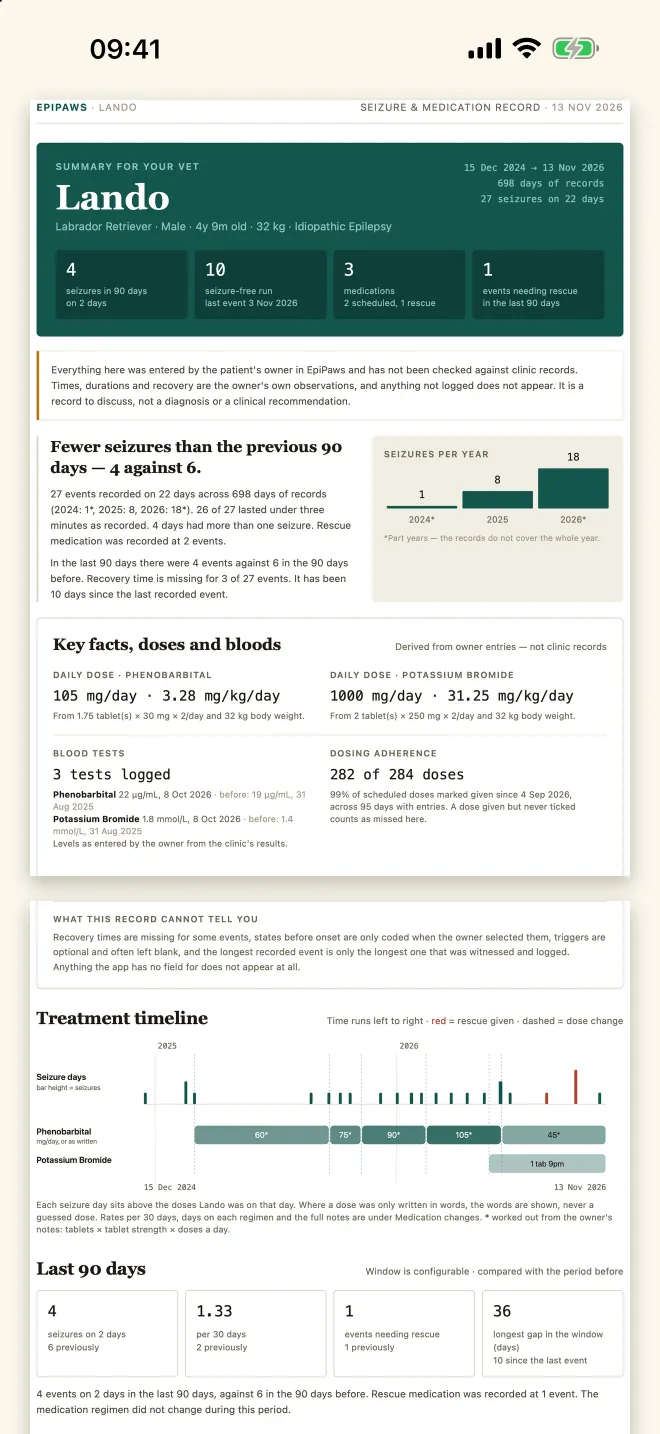
- Keep a dated seizure and medication history; insurers and vets both ask for it.
- Know your excess and your annual limit, so the renewal letter doesn’t surprise you.
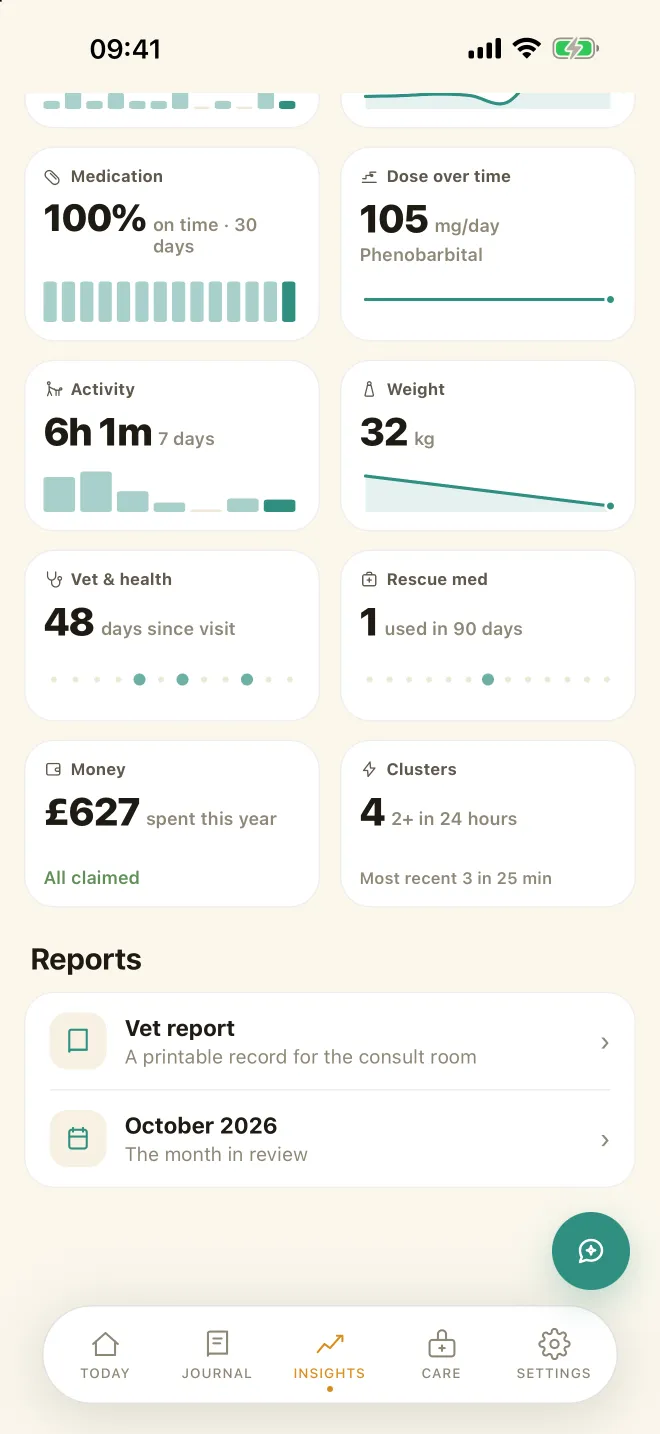
A clear history also helps your vet get more done in each appointment. See how to track seizures for the vet.
Frequently asked questions
How much does it cost to treat dog epilepsy?
Does my dog need an MRI to diagnose epilepsy?
Does pet insurance cover epilepsy in dogs?
Is epilepsy a pre-existing condition for pet insurance?
Can I reduce my dog’s seizure medication to save money?
Written by Jake Wise. I make EpiPaws and live with Lando, a Labrador with idiopathic epilepsy. I'm not a vet: this guide summarises published veterinary sources, which are linked inline and listed below. If you spot a mistake, email jake@rockethound.io.
Not veterinary advice. This is general information to help you talk to your vet. It can't diagnose your pet or tell you what dose to give. If a seizure lasts more than 5 minutes, or seizures come one after another without recovery in between, it's an emergency: call your vet or the nearest emergency clinic now.
Sources
- Langford Vets (University of Bristol). Neurology price guide, prices correct as at 1 May 2026. www.langfordvets.co.uk
- Insurance Times. Pet insurance payouts top £1bn for third consecutive year (reporting Association of British Insurers data for 2024), May 2025. www.insurancetimes.co.uk
- De Risio L, et al. International Veterinary Epilepsy Task Force consensus proposal: diagnostic approach to epilepsy in dogs. BMC Veterinary Research, 2015;11:148. pmc.ncbi.nlm.nih.gov
- Which?. Pet insurance explained (types of cover and pre-existing conditions), updated December 2025. www.which.co.uk
- National Association of Insurance Commissioners (US). Pet insurance consumer topic page, updated April 2025. content.naic.org
- National Association of Insurance Commissioners. Pet Insurance Model Act (MO-633), adopted 2022. content.naic.org
Keep reading
Dog epilepsy medication: phenobarbital, bromide and the rest
Phenobarbital, imepitoin, potassium bromide and levetiracetam explained, plus why blood tests matter and why you never stop suddenly.
How long do dogs with epilepsy live?
What studies from Denmark, Japan and the UK actually found, what changes the outlook, and the parts that are in your hands.
How to track your dog’s seizures for the vet
The checklist for every seizure, why the dates matter so much, and how to hand your vet the whole story on one page.