How to Track Your Dog's Seizures for the Vet
To track your dog's seizures for the vet, record the date, time, and exact duration of each one, what the body did, any warning signs beforehand, how your dog recovered afterward and for how long, plus possible triggers and every medication dose. If you safely can, film it — video helps your vet more than any description. Bring a dated summary to every appointment, because epilepsy treatment is adjusted based on how often and how severely seizures happen.
Why your vet needs a seizure log
If your dog has just been diagnosed with epilepsy, tracking seizures can feel like one more stressful job. But it's the single most useful thing you can do, for one simple reason: epilepsy medication is dosed against how often and how severely your dog seizures. Your vet can't see the seizures happening at home — your record is their only window into whether treatment is working.
A consistent log does three things: it aids diagnosis (the pattern and type of events matter), it lets you and your vet make treatment decisions with real data rather than guesswork, and it helps you spot triggers and patterns you'd never notice from memory alone.
What to record for every seizure
Aim to capture each of these, in the moment if you can, or straight afterward while it's fresh:
- Date and time of day — patterns often cluster around sleep, waking, or feeding.
- Duration — time it with your phone, noting the start and end. This number matters more than almost anything else.
- What the body did — which parts were affected, whether it was focal (one area) or whole-body, and whether your dog lost consciousness.
- Warning signs beforehand — restlessness, clinginess, hiding, or "spacing out" in the minutes or hours before.
- Recovery afterward — disorientation, pacing, temporary blindness, or exhaustion, and how long it lasted.
- Possible triggers (what to watch for) — stress, a missed meal, poor sleep, a new environment, or a missed medication dose.
- Medication — doses given, any missed doses, and any recent changes.
- Video, if safe — even 20 seconds helps your vet enormously.
The three stages of a seizure
Seizures usually unfold in three phases. Knowing them helps you record the right things at the right moment — and reassures you that the strange behaviour after a seizure is normal.
| Phase | When | What you might see — and log |
|---|---|---|
| Pre-ictal (aura) | Minutes to hours before | Restlessness, clinginess, hiding, whining. Logging this helps spot warning signs over time. |
| Ictal (the seizure) | Usually under 2 minutes | Collapse, paddling, stiffening, drooling, loss of awareness. Time it and, if safe, film it. |
| Post-ictal (recovery) | Minutes to hours after | Disorientation, pacing, temporary blindness, hunger, exhaustion. Note how long recovery takes. |
When a seizure is an emergency
Most single seizures, though frightening, are over within a couple of minutes and aren't an emergency in themselves. But some situations need a vet straight away:
- A seizure lasts more than 5 minutes — this is called status epilepticus and can be life-threatening.
- Your dog has more than one seizure in 24 hours (cluster seizures), even if each is brief.
- Your dog doesn't fully recover between seizures, or it's their first-ever seizure.
When in doubt, call for guidance rather than wait. This article isn't a substitute for veterinary advice — your vet knows your dog's history.
Paper, printable, or an app?
Any record beats no record. The question is what you'll actually keep up with at 3am.
A paper notebook or a free printable seizure log (several vets and charities offer one) works and costs nothing — but it's easy to forget, hard to search, and a pile of loose notes is awkward to hand a vet. A dedicated app removes the friction: you log in a few taps, it timestamps automatically, and it turns months of events into a clean summary. (If you're weighing options, see our comparison of the best dog seizure tracker apps.)
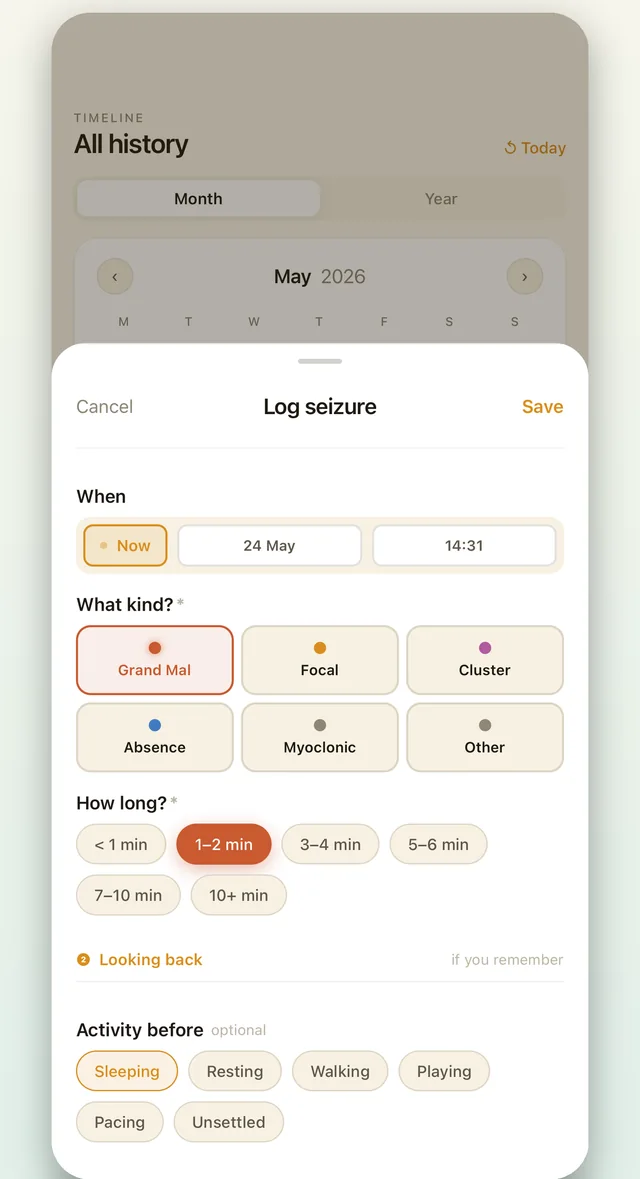
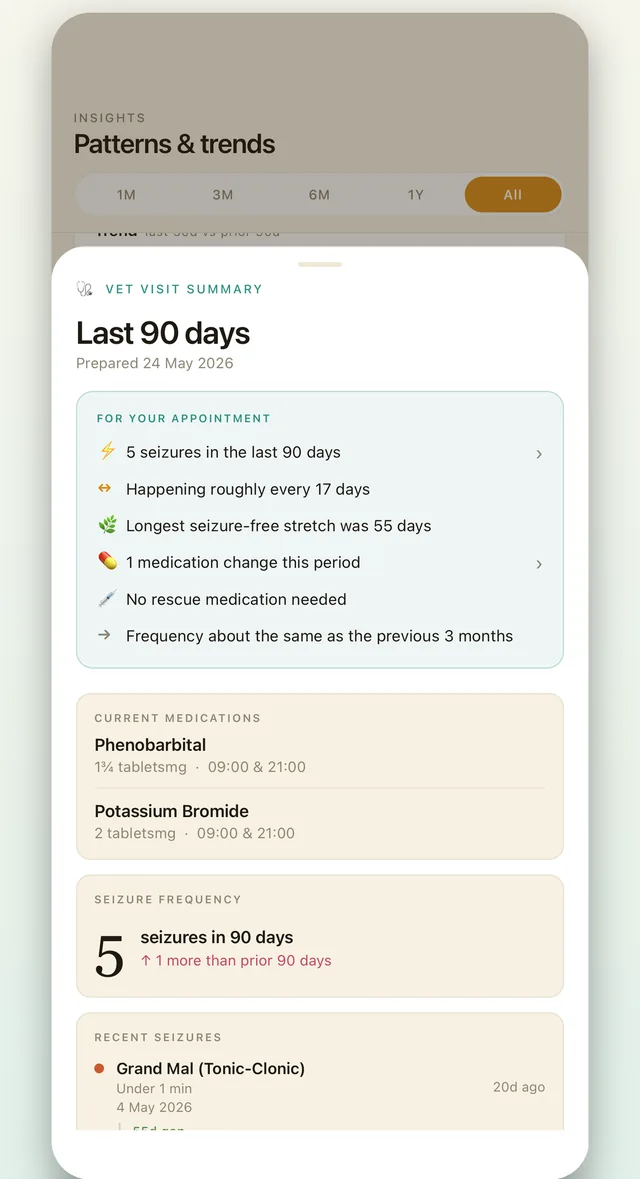
That's exactly what we built EpiPaws to do. You log a seizure in seconds, track medication and doses, and when it's time for a check-up it generates a vet-ready PDF of frequency, duration, and medication history — the format vets find easiest to act on.
Build a vet-ready seizure log, effortlessly
EpiPaws is free on iPhone — log seizures in seconds, track medication, and share a vet-ready PDF at your next appointment. Works for cats too.
Download EpiPaws — freeFrequently asked questions
How long do dog seizures usually last?
Most last under two minutes. A seizure over five minutes is status epilepticus — a medical emergency, so get to a vet immediately. More than one seizure in 24 hours (cluster seizures) also needs urgent attention.
What should I record about my dog's seizure?
Date, time, and exact duration; what the body did; warning signs beforehand; how your dog recovered afterward and for how long; possible triggers; and every medication dose. Video is extremely useful.
Should I film my dog having a seizure?
Yes, if you safely can. A short clip lets your vet see the type of movements and tell a true seizure from other episodes — far more useful than a description.
Why does my vet need a seizure log?
Epilepsy medication is adjusted based on seizure frequency and severity. An accurate log is what lets your vet judge whether treatment is working and what to change.