How long do dogs with epilepsy live?
The honest answer from the research: many dogs with idiopathic epilepsy live long lives, the outlook varies a lot, and control of seizures matters more than the diagnosis itself.

Many dogs with idiopathic epilepsy, the most common kind, live long lives. In a Danish study they had a median lifespan of 9.2 years, against 5.8 years for dogs whose seizures had a structural brain cause; a Japanese study of mostly small breeds found 13.5 and 10.9 years. The outlook is more guarded for dogs with cluster seizures or status epilepticus. How well seizures are controlled matters more than the diagnosis itself.
- The cause matters: idiopathic epilepsy carries a much better outlook than epilepsy from a brain tumour or other structural problem.
- In the Danish study, cluster seizures and status epilepticus were strongly linked to shorter survival.
- Remission (no seizures without medication) is uncommon: 14–15% in two studies.
- Many deaths in dogs with epilepsy are euthanasia decisions, which is why quality of life and good control matter so much.
- What owners can influence: steady dosing, acting fast on emergencies, and a clear record for the vet.
In this guide
- What is the life expectancy of a dog with epilepsy?
- What is the difference between idiopathic and structural epilepsy?
- What makes the outlook worse for a dog with epilepsy?
- Can a dog grow out of epilepsy?
- Why do so many epileptic dogs die by euthanasia?
- Can a dog with epilepsy have a good quality of life?
- Does tracking seizures change the outlook?
- Frequently asked questions
What is the life expectancy of a dog with epilepsy?
It depends on the type of epilepsy and how well seizures are controlled. The clearest figures come from two hospital-based studies:
- Denmark. In a university-hospital study by Fredsø et al., 2014, the median lifespan of dogs with idiopathic epilepsy was 9.2 years, against 5.8 years for dogs with a known structural cause in the brain. Across all dogs with epilepsy it was 7.6 years.
- Japan. Hamamoto et al., 2016 found a median lifespan of 13.5 years for idiopathic epilepsy and 10.9 years for structural epilepsy, in a population made up mainly of small breeds. Median survival after the first seizure was 10.4 and 4.5 years.
For context, a large study of dogs in England found a median lifespan of 12.0 years for dogs in general. An older Danish study of 63 dogs, Berendt et al., 2007, concluded that epilepsy carries an increased risk of dying early. So the honest picture is a wide range: many dogs do well, and some don’t.
What is the difference between idiopathic and structural epilepsy?
| Type | What it means | Outlook |
|---|---|---|
| Idiopathic epilepsy | Repeated seizures with no structural cause found; often genetic or presumed genetic. Usually starts between 6 months and 6 years of age. | Often good when seizures are controlled. |
| Structural epilepsy | Seizures caused by a problem in the brain, such as a tumour, inflammation, malformation or stroke. | Depends mainly on the underlying disease; shorter survival on average. |
| Reactive seizures | Seizures caused by something outside the brain, such as a toxin or low blood sugar. Not epilepsy. | Depends on the cause and whether it can be fixed. |
The categories and age range come from the International Veterinary Epilepsy Task Force (IVETF) definitions and diagnostic proposal. Your vet tells them apart with blood tests, a neurological examination and sometimes an MRI. About 0.62% of dogs seen by UK vets have epilepsy of unknown cause, according to a VetCompass study.
What makes the outlook worse for a dog with epilepsy?
- Cluster seizures and status epilepticus. In the Danish study both were significantly linked to shorter survival. See our guide to clusters and status epilepticus.
- Frequent seizures. In the Japanese study, a seizure frequency of 0.3 a month or more (roughly one every three months) was linked to shorter survival, as were focal seizures.
- Not responding to medication. About a third of dogs with idiopathic epilepsy are resistant to multiple drugs, according to the MSD (Merck) Veterinary Manual.
- A structural cause, which carries its own course.
These are patterns across groups of dogs, not a forecast for yours.
Can a dog grow out of epilepsy?
It happens, but it’s uncommon. Remission was 15% in the earlier Danish study and 14% in a UK study by Packer et al., 2014, which found dogs with a history of clusters were less likely to reach it. Most dogs need lifelong treatment. Never reduce or stop medication to “see if they’ve grown out of it”; that has to be a slow, vet-led process.
Why do so many epileptic dogs die by euthanasia?
It’s the hardest number in this guide. In the Danish study, 52% of the dogs with idiopathic epilepsy that had died were euthanised because of their epilepsy. Owners make that decision when seizures, side effects or the burden of care become too much, which is why the day-to-day side matters as much as the medical one.
Vets are there for this conversation too, long before it’s urgent. So is the cost question: our guide to the cost of dog epilepsy and insurance covers that honestly.
Can a dog with epilepsy have a good quality of life?
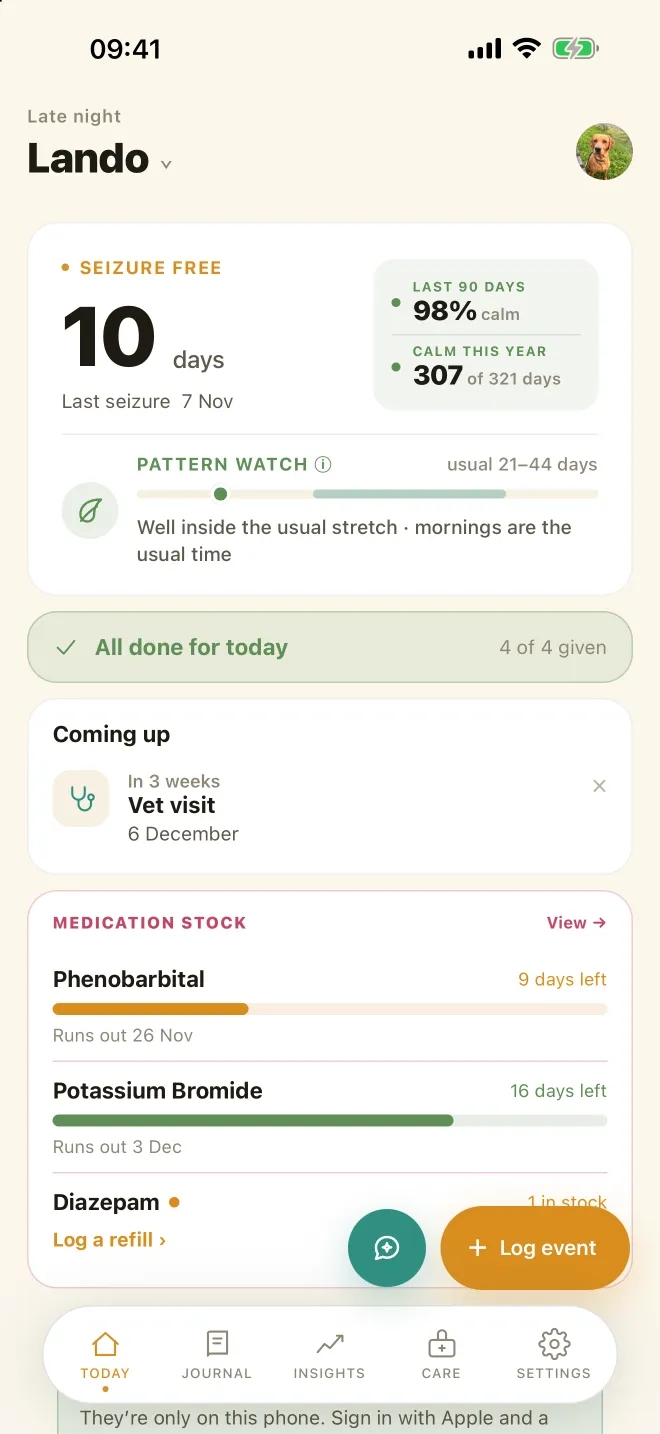
Yes. Lando has long calm stretches and the occasional bad week, which is a common pattern for dogs whose seizures are reasonably well controlled. Things that help:
- Steady medication, given on time, every time. See the medication guide.
- Knowing the emergencies and acting fast on them. See what to do during a seizure.
- Watching side effects, such as sleepiness, weight gain or wobbliness, and telling your vet.
- Predictable routines and good sleep, which some owners find helps.
Does tracking seizures change the outlook?
A log doesn’t change the disease. What it changes is how quickly problems are noticed. Seizures creeping closer together, a first cluster, or missed doses show up in days rather than at the next check-up, and your vet can adjust treatment with real numbers.
Frequently asked questions
What is the life expectancy of a dog with epilepsy?
Does epilepsy shorten a dog’s life?
What makes the prognosis worse for a dog with epilepsy?
Can a dog grow out of epilepsy?
Can a dog with epilepsy live a normal life?
Written by Jake Wise. I make EpiPaws and live with Lando, a Labrador with idiopathic epilepsy. I'm not a vet: this guide summarises published veterinary sources, which are linked inline and listed below. If you spot a mistake, email jake@rockethound.io.
Not veterinary advice. This is general information to help you talk to your vet. It can't diagnose your pet or tell you what dose to give. If a seizure lasts more than 5 minutes, or seizures come one after another without recovery in between, it's an emergency: call your vet or the nearest emergency clinic now.
Sources
- Fredsø N, Koch BC, Toft N, Berendt M. Risk factors for survival in a university hospital population of dogs with epilepsy. Journal of Veterinary Internal Medicine, 2014;28(6):1782–1788. pmc.ncbi.nlm.nih.gov
- Hamamoto Y, et al. Retrospective epidemiological study of canine epilepsy in Japan using the International Veterinary Epilepsy Task Force classification 2015 (2003–2013): etiological distribution, risk factors, survival time, and lifespan. BMC Veterinary Research, 2016;12:248. pmc.ncbi.nlm.nih.gov
- O'Neill DG, et al. Longevity and mortality of owned dogs in England. The Veterinary Journal, 2013;198(3):638–643. pubmed.ncbi.nlm.nih.gov
- Berendt M, Gredal H, Ersbøll AK, Alving J. Premature death, risk factors, and life patterns in dogs with epilepsy. Journal of Veterinary Internal Medicine, 2007;21(4):754–759. pubmed.ncbi.nlm.nih.gov
- Packer RMA, Shihab NK, Torres BBJ, Volk HA. Clinical risk factors associated with anti-epileptic drug responsiveness in canine epilepsy. PLoS One, 2014;9(8):e106026. pmc.ncbi.nlm.nih.gov
- Berendt M, et al. International Veterinary Epilepsy Task Force consensus report on epilepsy definition, classification and terminology in companion animals. BMC Veterinary Research, 2015;11:182. pmc.ncbi.nlm.nih.gov
- De Risio L, et al. International Veterinary Epilepsy Task Force consensus proposal: diagnostic approach to epilepsy in dogs. BMC Veterinary Research, 2015;11:148. pmc.ncbi.nlm.nih.gov
- Kearsley-Fleet L, O’Neill DG, Volk HA, Church DB, Brodbelt DC. Prevalence and risk factors for canine epilepsy of unknown origin in the UK. Veterinary Record, 2013;172(13):338. doi.org
- Charalambous M. Epilepsy in Small Animals. MSD Veterinary Manual (published in the US as the Merck Veterinary Manual), reviewed 2025. www.msdvetmanual.com