Cluster seizures and status epilepticus in dogs
The two seizure emergencies every owner of an epileptic dog should be able to recognise, what vets do about them, and how to be ready before one happens.

Cluster seizures are two or more seizures within 24 hours. Status epilepticus is a seizure lasting more than 5 minutes, or two or more seizures without full recovery in between. Status epilepticus is an emergency: call your vet or emergency clinic now. A cluster needs a call to your vet the same day, and to follow any rescue plan they've given you.
- Definitions come from the International Veterinary Epilepsy Task Force (IVETF): cluster = 2+ seizures in 24 hours; status epilepticus = over 5 minutes, or no recovery between seizures.
- Status epilepticus is life-threatening. One 2022 study of 124 dogs found short-term mortality of 29.8%.
- In a study of 407 dogs with idiopathic epilepsy, 41% had cluster seizures. German Shepherds and Boxers were more likely to cluster than Labradors.
- Rescue medicine at home only works if it is planned in advance with your vet. The 2024 ACVIM consensus favours intranasal midazolam for use outside the clinic.
- Exact times matter most. Log every seizure and the gaps between them.
In this guide
- What are cluster seizures in dogs?
- What is status epilepticus in dogs?
- How do I tell a single seizure, a cluster and status epilepticus apart?
- What should I do when a cluster starts?
- What is a rescue plan for cluster seizures?
- Which dogs are more likely to have cluster seizures?
- Do cluster seizures affect a dog's outlook?
- Why does a seizure log matter more with clusters?
- Frequently asked questions
What are cluster seizures in dogs?
Cluster seizures: two or more seizures within a 24-hour period. This is the definition in the IVETF consensus on definitions, and the one vets use.
Each seizure in a cluster can look exactly like your dog's usual seizures. What makes it a cluster is the timing. Two seizures on Tuesday evening are a cluster even if your dog seemed fine in between. One on Monday and one on Thursday are not.
Clusters are common in dogs with epilepsy. In a referral-hospital study of 407 dogs with idiopathic epilepsy, 169 (41%) had cluster seizures. They matter because they often mean daily treatment needs reviewing, and because they can run on into status epilepticus.
What is status epilepticus in dogs?
Status epilepticus: more than 5 minutes of continuous seizure activity, or two or more seizures without full recovery of consciousness between them (IVETF).
Most generalised seizures last one to two minutes, according to VCA Animal Hospitals. A seizure that is still going at five minutes is unlikely to stop by itself, and Cornell advises going to the veterinary clinic immediately.
It is dangerous. In a 2022 study of 124 dogs treated for status epilepticus, short-term mortality was 29.8%, and 27% of the dogs that survived had another episode later.
A seizure lasting more than 5 minutes, or seizures one after another without your pet recovering in between, is an emergency. Call your vet or the nearest emergency clinic now and tell them you're on your way. A first-ever seizure also needs a call to your vet the same day, even if your pet seems fine afterwards.
How do I tell a single seizure, a cluster and status epilepticus apart?
| Pattern | What you see | What to do |
|---|---|---|
| Single seizure | One seizure, usually 1–2 minutes, then a confused or wobbly recovery | Keep your dog safe and write it down. Tell your vet; call them the same day if it is the first seizure ever. |
| Cluster seizures | Two or more separate seizures within 24 hours, with your dog coming round between them | Call your vet today. Follow your written rescue plan if you have one. Log each seizure and the gap since the last. |
| Status epilepticus | A seizure over 5 minutes, or seizures with no proper recovery in between | Call your vet or emergency clinic now and travel in. Don’t wait to see if it settles. |
Also go in straight away if your dog has trouble breathing, overheats and can't cool down, is injured, or might have eaten something toxic, or if the seizures are coming closer and closer together.
What should I do when a cluster starts?
- Start the clock
Note the time each seizure starts and stops. In a cluster, the gaps between seizures matter as much as the seizures.
- Keep your dog safe
Clear the space, keep them off the stairs and away from water, dim the lights, and keep your hands away from their mouth.
- Apply the 5-minute rule
Still seizing at 5 minutes, or a new seizure before your dog has come round? That is status epilepticus: call now.
- Follow your rescue plan exactly
If your vet has prescribed rescue medication, give it as they showed you and note the time. Never use medicine that wasn’t prescribed for this dog.
- Call your vet
Even if the cluster stops, call the same day. On the phone, they will want the start time, how long each seizure lasted and how many there have been today.
- Take the record with you
Bring the seizure times, current medicines and doses, and any rescue medication given.
For the basics of keeping your dog safe during any seizure, see what to do when your dog has a seizure.
What is a rescue plan for cluster seizures?
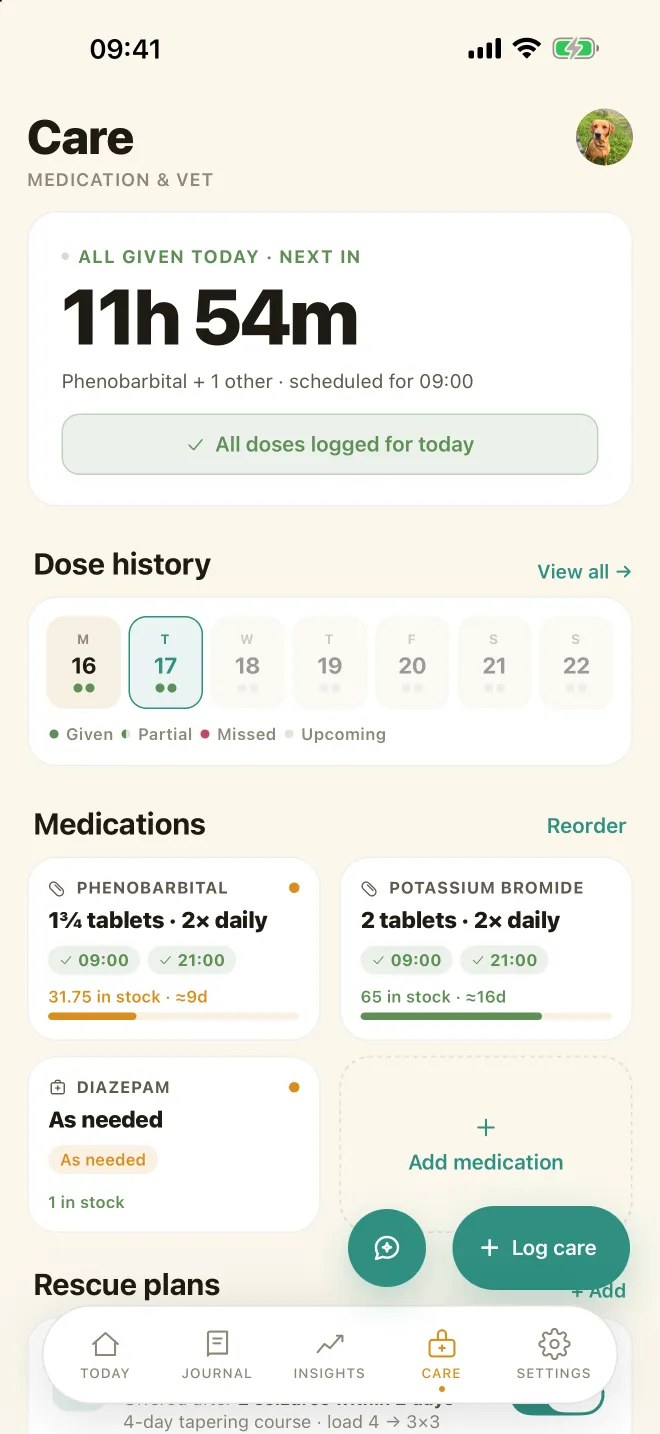
For dogs that have had clusters, many vets write a rescue plan: which medicine to give at home, how much, when to give it, and when to stop and drive in. It has to be set up in advance; you can't improvise one during a seizure.
The 2024 ACVIM consensus statement on status epilepticus and cluster seizures reviewed the evidence for treatment outside the clinic. For dogs it gives its strongest recommendation to intranasal midazolam for status epilepticus at home, and says rectal diazepam "is unlikely to be as potent or fast acting". For clusters it lists intranasal midazolam, rectal diazepam, and short "pulse" courses of oral levetiracetam as options.
Only give rescue medication your vet has prescribed for your dog, at the dose they set. Never use human sedatives or someone else’s seizure medicine. If you have given a rescue dose, tell the vet exactly what and when.
Which dogs are more likely to have cluster seizures?
Any dog with epilepsy can cluster. Studies have found some patterns across groups of dogs, which can help you and your vet decide whether to have a rescue plan ready:
- Breed. In the 407-dog study, German Shepherds and Boxers were more likely to have clusters than Labradors.
- Sex and neutering. The same study found entire (unneutered) males about twice as likely to cluster as neutered males. Other studies disagree, so treat this cautiously.
- History. Clusters and status epilepticus tend to travel together.
These are population patterns, not predictions for your dog. A Labrador can still cluster, and a German Shepherd may never do so.
Do cluster seizures affect a dog's outlook?
They can. In a Danish university-hospital study, cluster seizures and status epilepticus were both linked to shorter survival. A UK study found dogs with a history of clusters were less likely to reach remission. The IVETF treatment proposal lists cluster seizures and status epilepticus among the reasons to start long-term medication, and its diagnostic proposal suggests an MRI scan after them.
Many dogs that cluster still live well for years once treatment is adjusted. Our guide to life expectancy with epilepsy covers the numbers.
Why does a seizure log matter more with clusters?
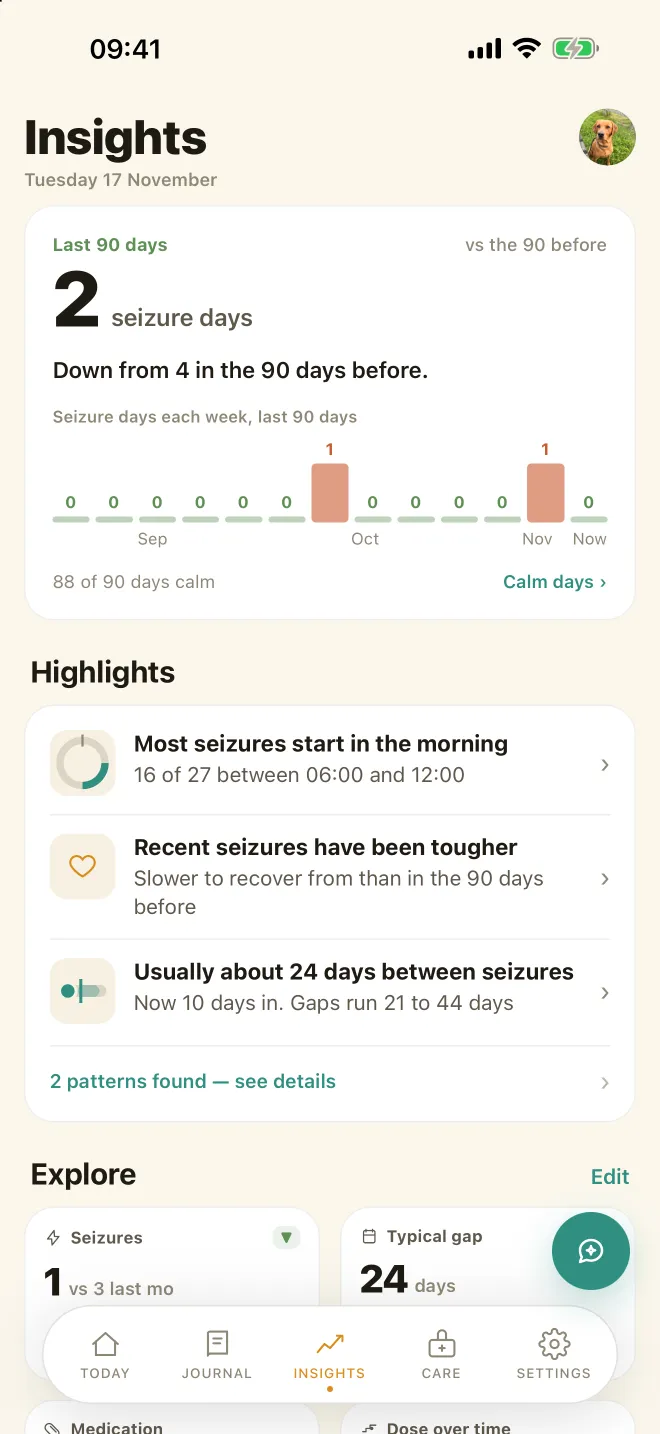
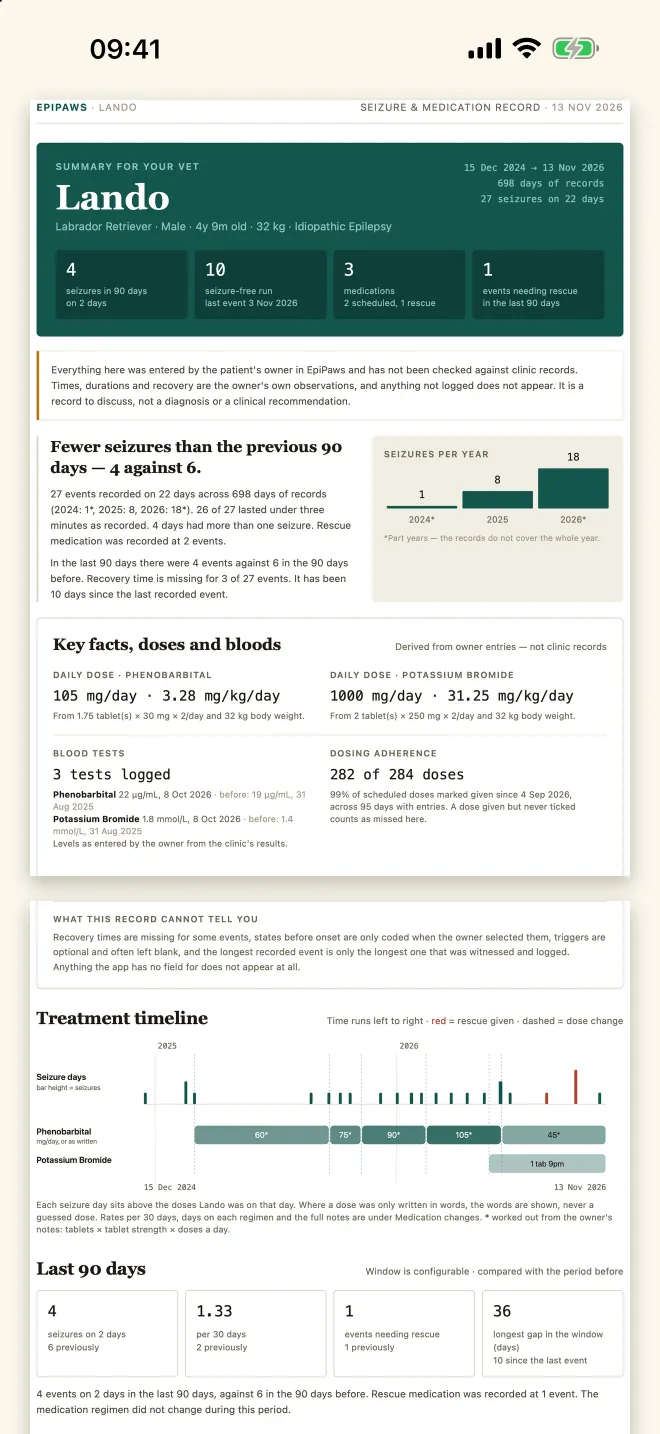
With single seizures, a monthly count tells your vet a lot. With clusters, they need timestamps: how many in 24 hours, how long the gaps were, whether the gaps were shortening, and whether rescue medication changed anything. That's the evidence for changing a dose or adding a drug.
Write each one down as it ends. By the third seizure of a long night, memory is unreliable. See how to track seizures for the vet for what to record, and our medication guide for how treatment is adjusted.
Frequently asked questions
What counts as a cluster seizure in dogs?
What is the difference between cluster seizures and status epilepticus?
Are cluster seizures an emergency?
What rescue medication is used for cluster seizures in dogs?
Which dogs are more likely to have cluster seizures?
Do cluster seizures shorten a dog’s life?
Written by Jake Wise. I make EpiPaws and live with Lando, a Labrador with idiopathic epilepsy. I'm not a vet: this guide summarises published veterinary sources, which are linked inline and listed below. If you spot a mistake, email jake@rockethound.io.
Not veterinary advice. This is general information to help you talk to your vet. It can't diagnose your pet or tell you what dose to give. If a seizure lasts more than 5 minutes, or seizures come one after another without recovery in between, it's an emergency: call your vet or the nearest emergency clinic now.
Sources
- Berendt M, et al. International Veterinary Epilepsy Task Force consensus report on epilepsy definition, classification and terminology in companion animals. BMC Veterinary Research, 2015;11:182. pmc.ncbi.nlm.nih.gov
- Charalambous M, et al. ACVIM Consensus Statement on the management of status epilepticus and cluster seizures in dogs and cats. Journal of Veterinary Internal Medicine, 2024;38(1):19–40. pmc.ncbi.nlm.nih.gov
- Fentem R, et al. Risk factors associated with short-term mortality and recurrence of status epilepticus in dogs. Journal of Veterinary Internal Medicine, 2022;36(2):656–662. pmc.ncbi.nlm.nih.gov
- Monteiro R, Adams V, Keys D, Platt SR. Canine idiopathic epilepsy: prevalence, risk factors and outcome associated with cluster seizures and status epilepticus. Journal of Small Animal Practice, 2012;53(9):526–530. pubmed.ncbi.nlm.nih.gov
- Fredsø N, Koch BC, Toft N, Berendt M. Risk factors for survival in a university hospital population of dogs with epilepsy. Journal of Veterinary Internal Medicine, 2014;28(6):1782–1788. pmc.ncbi.nlm.nih.gov
- Packer RMA, Shihab NK, Torres BBJ, Volk HA. Clinical risk factors associated with anti-epileptic drug responsiveness in canine epilepsy. PLoS One, 2014;9(8):e106026. pmc.ncbi.nlm.nih.gov
- Bhatti SFM, et al. International Veterinary Epilepsy Task Force consensus proposal: medical treatment of canine epilepsy in Europe. BMC Veterinary Research, 2015;11:176. pmc.ncbi.nlm.nih.gov
- De Risio L, et al. International Veterinary Epilepsy Task Force consensus proposal: diagnostic approach to epilepsy in dogs. BMC Veterinary Research, 2015;11:148. pmc.ncbi.nlm.nih.gov
- VCA Animal Hospitals. Seizures in Dogs (owner information). vcahospitals.com
- Cornell University College of Veterinary Medicine, Riney Canine Health Center. Managing seizures. www.vet.cornell.edu
Keep reading
What to do when your dog has a seizure
Keep them safe, time it, hands away from the mouth, and the 5-minute rule that tells you when to call. The guide to read before you need it.
How long do dogs with epilepsy live?
What studies from Denmark, Japan and the UK actually found, what changes the outlook, and the parts that are in your hands.
How to track your dog’s seizures for the vet
The checklist for every seizure, why the dates matter so much, and how to hand your vet the whole story on one page.