CBD for dog seizures: what the research actually shows
Three small placebo-controlled trials, one systematic review, and a lot of marketing. This is what the studies found, what they didn’t, and what to ask your vet.

CBD isn’t a proven treatment for dog seizures. Three small placebo-controlled trials in dogs still having seizures on medication found fewer seizures on average when CBD was added, but in two of the three, no more dogs halved their seizures than on placebo. A 2025 systematic review rated all three at moderate to high risk of bias and said no firm conclusions are possible. CBD raised liver enzymes in the trials, and it is never a replacement for prescribed medicine.
- Every trial tested CBD as an add-on in dogs whose seizures weren’t controlled. None tested it alone.
- Average seizure counts fell, but only one small trial found more “responders” (50%+ fewer seizures) than placebo.
- A rise in the liver enzyme ALP was reported in the trials; vets recommend monitoring liver values.
- In the UK, the Veterinary Medicines Directorate treats CBD products for animals as veterinary medicines. In the US, the FDA hasn’t approved any CBD product for animals.
- Product contents vary: in one analysis, only 10 of 27 products were within 10% of their label claim.
In this guide
Does CBD work for seizures in dogs?
The honest answer is: maybe a little, in some dogs, and the evidence is weak. Cannabidiol (CBD) is a compound from the hemp plant. It doesn’t make people or dogs “high”; that’s THC.
A 2025 systematic review by researchers at the University of Copenhagen, Jensen et al., 2025, looked at every randomised trial of CBD for drug-resistant epilepsy in dogs. There were three. All suggested fewer seizures and all reported wobbliness (ataxia), but all had a moderate to high risk of bias, and the authors concluded it is “not possible to draw conclusions” about efficacy or side effects.
What did the CBD trials in dogs find?
| Study | Dogs | What happened | Responders (50%+ fewer) |
|---|---|---|---|
| McGrath 2019 | 26 randomised; 9 on CBD and 7 on placebo analysed | A median 33% fewer seizures on CBD, compared with placebo. ALP (a liver enzyme) rose. | No difference from placebo |
| Garcia 2022 | 14, crossover (each dog had both) | Mean seizures 5.0 on hemp extract vs 8.0 on placebo over 12 weeks. Phenobarbital, bromide and zonisamide levels were unchanged. Funded by the product’s maker. | 6 of 14 vs 0 of 14 |
| Rozental 2023 | 51, crossover; 39 at the higher dose | Seizure days fell 24.1% on CBD and rose 5.8% on placebo. A lower dose was dropped early for lack of effect. Liver enzymes rose; less appetite and more vomiting. | Not significantly different |
Read across the rows and a pattern appears: averages went down, but the share of dogs with a clinically meaningful improvement mostly didn’t beat placebo. That’s a modest signal, not a breakthrough.
Is CBD safe for dogs on seizure medication?
- Liver enzymes. ALP rose in the trials. In the largest, the authors concluded that “liver enzymes should be monitored” in dogs given CBD. Phenobarbital can also raise liver enzymes, which makes results harder to read.
- Other effects. Wobbliness, reduced appetite and vomiting were reported. Wobbliness overlaps with the side effects of phenobarbital and bromide.
- Medicine levels. In the Garcia trial, blood levels of phenobarbital, bromide and zonisamide didn’t change. Interactions with other medicines are less well studied.
Stopping or cutting an anti-seizure medicine suddenly can trigger severe seizures or status epilepticus. If CBD seems to help, talk to your vet; never use it as a reason to skip a dose.
Is CBD legal for dogs in the UK and US?
In the UK, the Veterinary Medicines Directorate considers veterinary products containing CBD to be veterinary medicines, which need authorisation. A vet can prescribe a CBD product under the “cascade” rules when they judge it appropriate.
In the US, the FDA says it has not approved any animal products containing CBD; the only approved CBD product is a human prescription drug.
What is actually in CBD pet products?
Quality varies. A 2020 analysis of 29 over-the-counter hemp products for pets, Wakshlag et al., 2020, found only 10 of 27 within 10% of the cannabinoid content on their label, and heavy metals in 4. Products made for people may contain THC or sweeteners such as xylitol, which is toxic to dogs. If you and your vet decide to try CBD, ask them which product they would be comfortable with.
How do I know if CBD is helping my dog?
Only a log can tell you. In the Garcia trial, owners’ own diaries showed fewer seizures on CBD, but at the end of each phase the owners didn’t perceive any difference. Memory is a poor instrument for events that happen a few times a month.
- Bring your seizure record to the conversation. It tells your vet whether your dog is truly drug-resistant, the only group CBD has been studied in, or whether a medicine adjustment is the better next step.
- Agree what “working” means before you start, and for how long you’ll try.
- Ask about blood tests before and during.
- Change one thing at a time, and log side effects as well as seizures.
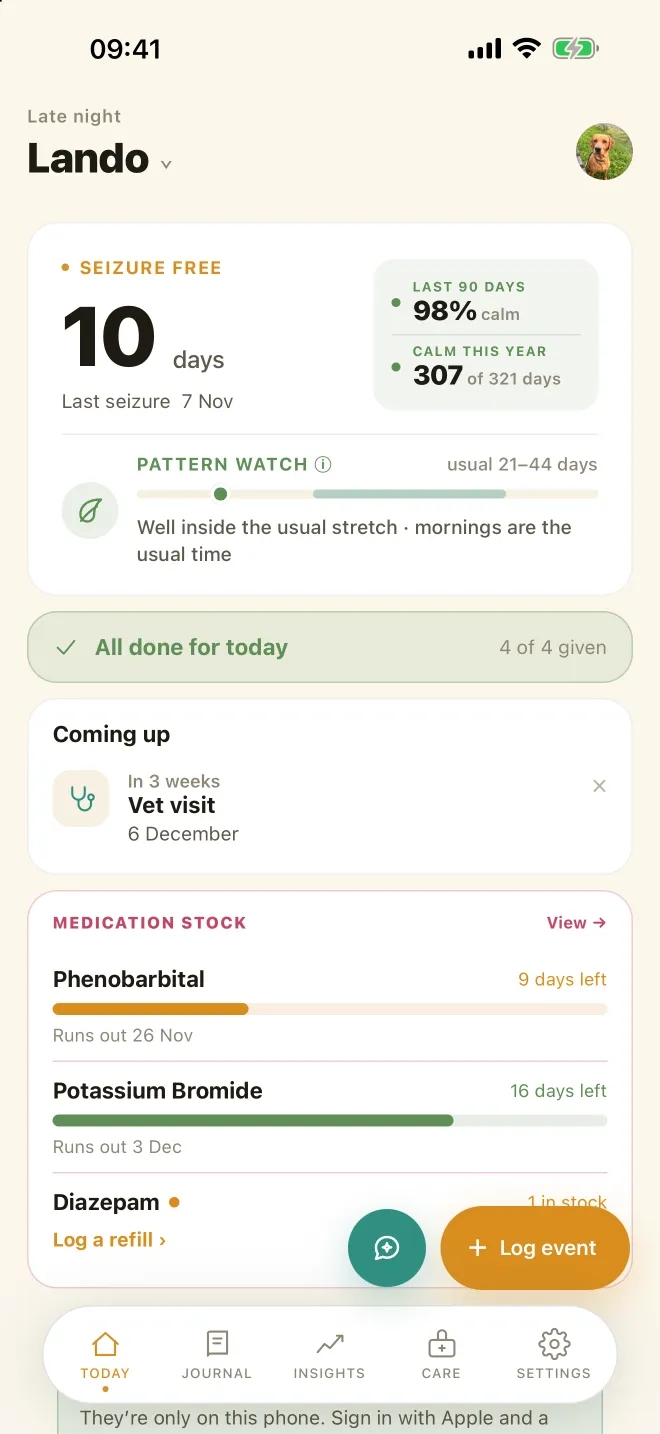
Our guide to tracking seizures for the vet explains what to record. And remember a log also shows things CBD can’t fix: if seizures follow missed doses or bad nights, see dog seizure triggers.
So, should I give my dog CBD for seizures?
- If seizures are well controlled on medicine, there’s no evidence that adding CBD improves anything.
- If they aren’t, CBD is one option your vet may discuss, alongside checking blood levels, adjusting doses, adding a second medicine, or a diet change such as MCTs.
- If you try it, do it with your vet, with a defined product, a long enough trial and a seizure log.
A seizure lasting more than 5 minutes, or seizures one after another without your pet recovering in between, is an emergency. Call your vet or the nearest emergency clinic now and tell them you're on your way. A first-ever seizure also needs a call to your vet the same day, even if your pet seems fine afterwards.
Frequently asked questions
Does CBD stop seizures in dogs?
Can CBD replace phenobarbital?
Is CBD safe for dogs with epilepsy?
Is CBD legal for dogs in the UK?
How can I tell if CBD is helping my dog?
Written by Jake Wise. I make EpiPaws and live with Lando, a Labrador with idiopathic epilepsy. I'm not a vet: this guide summarises published veterinary sources, which are linked inline and listed below. If you spot a mistake, email jake@rockethound.io.
Not veterinary advice. This is general information to help you talk to your vet. It can't diagnose your pet or tell you what dose to give. If a seizure lasts more than 5 minutes, or seizures come one after another without recovery in between, it's an emergency: call your vet or the nearest emergency clinic now.
Sources
- Jensen HA, Olsen A, Arendt M, Sandøe P, Nielsen SS. Cannabidiol treatment for refractory idiopathic epilepsy in dogs: a systematic review with risk of bias assessment. Preventive Veterinary Medicine, 2025;245:106649. doi.org
- McGrath S, et al. Randomized blinded controlled clinical trial to assess the effect of oral cannabidiol administration in addition to conventional antiepileptic treatment on seizure frequency in dogs with intractable idiopathic epilepsy. JAVMA, 2019;254(11):1301–1308. doi.org
- Garcia GA, et al. Safety and efficacy of cannabidiol-cannabidiolic acid rich hemp extract in the treatment of refractory epileptic seizures in dogs. Frontiers in Veterinary Science, 2022;9:939966. pmc.ncbi.nlm.nih.gov
- Rozental AJ, et al. The efficacy and safety of cannabidiol as adjunct treatment for drug-resistant idiopathic epilepsy in 51 dogs: a double-blinded crossover study. Journal of Veterinary Internal Medicine, 2023;37(6):2291–2300. pmc.ncbi.nlm.nih.gov
- Veterinary Medicines Directorate (GOV.UK). VMD statement on veterinary medicinal products containing cannabidiol, 2018. www.gov.uk
- US Food and Drug Administration. FDA warns four companies illegally selling CBD products intended for use in food-producing animals, 2022. www.fda.gov
- Wakshlag JJ, et al. Cannabinoid, terpene, and heavy metal analysis of 29 over-the-counter commercial veterinary hemp supplements. Veterinary Medicine: Research and Reports, 2020;11:45–55. www.dovepress.com
Keep reading
Diet for dogs with seizures: what the evidence says
MCT oil, keto, gluten and grain-free: what the trials show, and the food change that can quietly unsettle potassium bromide.
Dog epilepsy medication: phenobarbital, bromide and the rest
Phenobarbital, imepitoin, potassium bromide and levetiracetam explained, plus why blood tests matter and why you never stop suddenly.
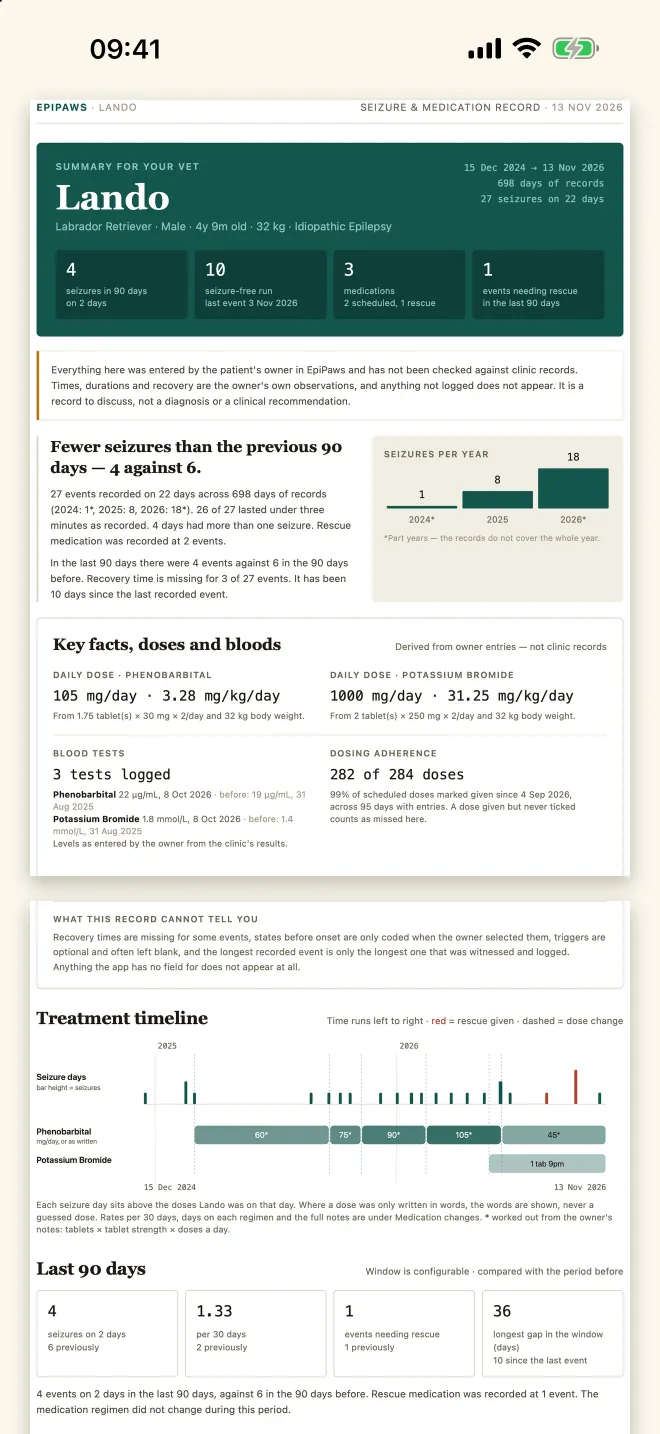
How to track your dog’s seizures for the vet
The checklist for every seizure, why the dates matter so much, and how to hand your vet the whole story on one page.