Diet for dogs with seizures: what the evidence says
No food cures epilepsy. One dietary change has trial evidence as an add-on, one common change can unsettle a medicine, and a few foods are genuinely dangerous.

No diet has been shown to stop seizures, and food can’t replace anti-seizure medicine. The best-supported change is adding medium-chain triglycerides (MCTs) alongside medication: two randomised trials found a modest drop in seizures, with some dogs responding well and many not at all. Feed a complete, consistent diet, and talk to your vet before changing food, especially if your dog takes potassium bromide, because salt levels in food change bromide levels in the blood.
- MCTs are the only dietary change with randomised-trial evidence in epileptic dogs, as an add-on to medicine.
- In the first trial, 10 of 21 dogs had at least 50% fewer seizures on an MCT diet; 6 didn’t respond.
- On potassium bromide, a change in dietary salt can push the level too low (seizures) or too high (toxicity).
- Gluten-free diets help a specific movement disorder in Border Terriers, not epilepsy in general.
- Xylitol and chocolate can cause seizures outright. Call your vet straight away if your dog eats them.
In this guide
Is there a best diet for dogs with seizures?
No single diet has been shown to stop seizures in dogs. Anti-seizure medicine is the foundation of treatment, and diet plays a supporting role: it can help a little in some dogs, it can do harm if done badly, and it can interfere with medicine if changed without telling your vet.
The sensible baseline is a complete, balanced diet suited to your dog’s age and health, fed consistently.
Does MCT oil help dogs with epilepsy?
It may help some dogs, a little. Medium-chain triglycerides (MCTs) are fats that the body handles differently from most dietary fats, producing ketones the brain can use as fuel. Two randomised controlled trials have tested them in dogs that stayed on their usual medicine:
- Law et al. (2015) compared an MCT diet with a placebo diet in 21 dogs. Median seizure frequency was 2.31 a month on the MCT diet against 2.67 on placebo. Three dogs became seizure-free, seven more had at least 50% fewer seizures, five had smaller improvements, and six showed no response.
- Berk et al. (2020) added MCT oil (9% of daily energy) to the usual diet of 28 dogs. Median seizure frequency was 2.51 a month on MCT oil against 2.67 on a control oil, and seizure days 1.68 against 1.99. Two dogs became seizure-free and three more halved their seizures; eleven showed no change or got worse. The oil was well tolerated.
That’s a real but modest effect. If you want to try it, ask your vet: the amount matters, MCTs add calories, and a sudden change can upset the stomach. The trials used an MCT diet or MCT oil, not coconut oil.
How do popular diets compare for dogs with seizures?
| Approach | Evidence | Worth knowing |
|---|---|---|
| MCT diet or MCT oil | Two randomised trials: modest reduction | An add-on to medicine, not a replacement. Agree the amount with your vet. |
| Strict ketogenic diet | Not established in dogs | Not a home project. Long-term very high-fat feeding has its own risks. |
| Gluten-free | Evidence for one disorder in one breed | Helps paroxysmal gluten-sensitive dyskinesia in Border Terriers, a movement disorder rather than epilepsy. |
| Grain-free | No evidence for seizure control | The US FDA has investigated a possible link between some diets and heart disease (DCM). |
| Home-cooked or raw | No evidence for seizure control | 95% of 200 published home-made recipes were short of at least one essential nutrient. |
| Supplements | Thin or none for most | Some interact with medicines. Check every one with your vet. |
Sources: Lowrie 2015 and 2018 (Border Terriers), US FDA (grain-free and DCM; the FDA has said it won’t publish further updates without meaningful new science), Stockman 2013 (home-made recipes).
Why does diet matter if my dog takes potassium bromide?
This is the most practically important point on the page. Bromide and chloride (from salt) compete in the kidneys. The MSD (Merck) Veterinary Manual says high-chloride diets increase bromide loss, lowering blood levels, and that dietary chloride should stay constant. The IVETF treatment proposal says the same.
- More salt → bromide level falls → risk of breakthrough seizures.
- Much less salt → bromide builds up → risk of toxicity (bromism): sleepiness and wobbliness.
It happens in real life. Fantinati et al., 2021 describe a dog whose owners changed its food without veterinary advice. The new diet had 53% less chloride, the dog’s bromide level rose by 103%, and it became wobbly. It recovered after its vet reduced the dose.
If your dog takes potassium bromide, treat “I changed his food” as medical information. Tell your vet before switching, including treats, and expect them to recheck the bromide level afterwards.
Can food trigger seizures in dogs?
Documented food triggers in canine epilepsy are rare. The clearest example is the Border Terrier disorder above, where affected dogs improved on a strict gluten-free diet and two relapsed when gluten treats came back. Other owner-reported food triggers are mostly anecdotal, which is a reason to log them rather than ignore them. See our guide to dog seizure triggers.
Anything that causes vomiting or diarrhoea can also affect how well medicine is absorbed, so a food that upsets your dog’s stomach can matter indirectly.
Xylitol (in some sugar-free gum, sweets and peanut butter) can cause dangerously low blood sugar within 30 minutes, with seizures, according to the MSD Veterinary Manual. Chocolate, especially dark and baking chocolate, can cause seizures; signs usually start within 6 to 12 hours (MSD). If your dog eats either, call your vet straight away, before signs appear. And whatever the cause, a seizure lasting more than 5 minutes, or seizures one after another without recovery, is an emergency: call now.
How do I trial a diet change properly?
Seizure frequency goes up and down on its own, so almost anything started during a bad spell looks as if it worked. A fair trial needs a baseline and patience.
- Agree it with your vet
Check the diet suits your dog’s other needs, and flag medicines that need monitoring, especially potassium bromide.
- Write down your baseline
At least three months of seizure dates before the change, including cluster days.
- Change one thing at a time
If diet and medicine change in the same month, you can’t tell which did what.
- Switch gradually
Mix the new food in over about a week to avoid stomach upsets.
- Log everything for three months
Every seizure, every missed dose, and side effects such as loose stools, weight change or new sleepiness.
- Compare the numbers, not impressions
Seizures and seizure days per month, before and after. Memory is unreliable in both directions.
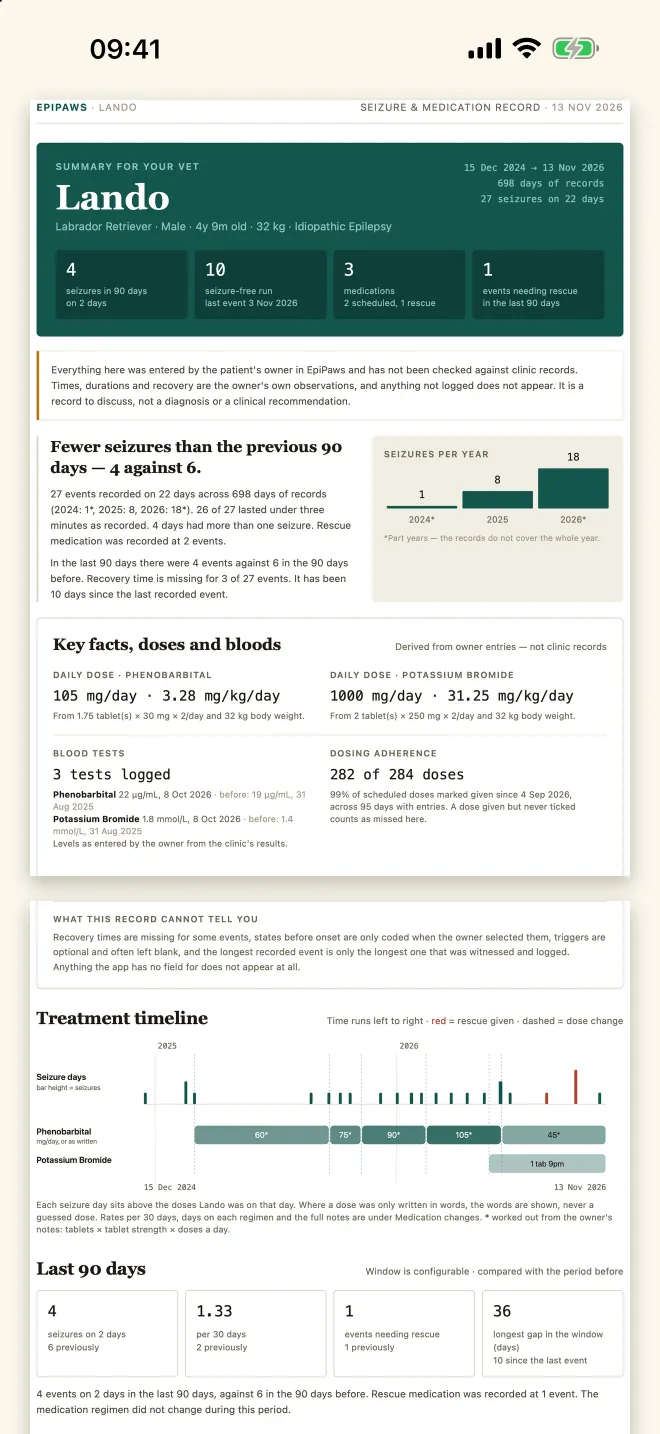
See how to track seizures for the vet for what to record.
Frequently asked questions
What is the best diet for a dog with seizures?
Does MCT oil stop seizures in dogs?
Can changing my dog’s food affect their epilepsy medication?
Should a dog with epilepsy eat grain-free or gluten-free food?
Can I feed my epileptic dog a home-cooked diet?
How long should I trial a diet before deciding if it works?
Written by Jake Wise. I make EpiPaws and live with Lando, a Labrador with idiopathic epilepsy. I'm not a vet: this guide summarises published veterinary sources, which are linked inline and listed below. If you spot a mistake, email jake@rockethound.io.
Not veterinary advice. This is general information to help you talk to your vet. It can't diagnose your pet or tell you what dose to give. If a seizure lasts more than 5 minutes, or seizures come one after another without recovery in between, it's an emergency: call your vet or the nearest emergency clinic now.
Sources
- Law TH, et al. A randomised trial of a medium-chain TAG diet as treatment for dogs with idiopathic epilepsy. British Journal of Nutrition, 2015;114(9):1438–1447. pmc.ncbi.nlm.nih.gov
- Berk BA, et al. A multicenter randomized controlled trial of medium-chain triglyceride dietary supplementation on epilepsy in dogs. Journal of Veterinary Internal Medicine, 2020;34(3):1248–1259. pmc.ncbi.nlm.nih.gov
- Castel A. Anticonvulsants for Treatment of Animals. MSD Veterinary Manual (Merck Veterinary Manual in the US), reviewed 2025. www.msdvetmanual.com
- Bhatti SFM, et al. International Veterinary Epilepsy Task Force consensus proposal: medical treatment of canine epilepsy in Europe. BMC Veterinary Research, 2015;11:176. pmc.ncbi.nlm.nih.gov
- Fantinati M, Priymenko N, Debreuque M. Bromide toxicosis (bromism) secondary to a decreased chloride intake after dietary transition in a dog with idiopathic epilepsy: a case report. BMC Veterinary Research, 2021;17:253. pmc.ncbi.nlm.nih.gov
- Lowrie M, et al. The clinical and serological effect of a gluten-free diet in Border Terriers with epileptoid cramping syndrome. Journal of Veterinary Internal Medicine, 2015;29(6):1564–1568. pmc.ncbi.nlm.nih.gov
- Lowrie M, et al. Characterization of paroxysmal gluten-sensitive dyskinesia in Border Terriers using serological markers. Journal of Veterinary Internal Medicine, 2018;32(2):775–781. pmc.ncbi.nlm.nih.gov
- US Food and Drug Administration. FDA Investigation into Potential Link between Certain Diets and Canine Dilated Cardiomyopathy (updated December 2022). www.fda.gov
- Stockman J, Fascetti AJ, Kass PH, Larsen JA. Evaluation of recipes of home-prepared maintenance diets for dogs. Journal of the American Veterinary Medical Association, 2013;242(11):1500–1505. doi.org
- MSD Veterinary Manual. Xylitol Toxicosis in Dogs. www.msdvetmanual.com
- MSD Veterinary Manual. Chocolate Toxicosis in Animals. www.msdvetmanual.com