Dog Seizure Triggers: What Sets Them Off, and How to Find Your Dog's
Most seizures in dogs with epilepsy have no identifiable trigger and tend to happen while the dog is resting or asleep. When triggers do exist, the most commonly reported are stress or excitement, disrupted sleep, certain foods, weather and barometric changes, hormonal cycles, and environmental factors like fireworks or household chemicals — plus a missed medication dose. Triggers are highly individual, so the only reliable way to find your dog's is to log every seizure alongside what happened in the hours before, then look for patterns over several weeks.
First, the honest truth about triggers
It's natural to hunt for the thing that "caused" a seizure — but for most dogs with idiopathic epilepsy, there isn't one. Seizures most often strike when a dog is calm, resting, or asleep, frequently overnight, with nothing obvious beforehand. If your dog seizes "out of nowhere," that's the norm, not a sign you missed something.
That said, some dogs do have recognisable triggers, and identifying them can sometimes help reduce how often seizures happen. The catch is that triggers are highly individual — what sets off one dog does nothing to another — so the published lists below are a starting point for what to watch, not a checklist that applies to every dog.
The most commonly reported triggers
These are the seizure-precipitating factors owners and researchers report most often, including in studies from the Royal Veterinary College:
| Trigger | What it can look like |
|---|---|
| Stress & excitement | Visitors, a change in routine, feeding time, or boisterous play — high arousal of any kind. |
| Disrupted sleep | Sleep deprivation or a broken routine; poor sleep is one of the most frequently reported factors. |
| Diet & specific foods | Certain foods or treats that some owners link to events; changes in diet. |
| Weather & pressure | Storms and shifts in barometric pressure are commonly reported around seizure clusters. |
| Hormonal cycles | In un-spayed females, seizures sometimes track with the season cycle. |
| Environment | Fireworks, thunder, loud noise, or household chemicals like cleaning products and air fresheners. |
| Missed medication | The most preventable trigger of all — a late or missed dose can let seizures break through. |
How to find your dog's triggers
Because triggers are individual, finding yours is detective work — and the evidence is a consistent log. Here's the approach:
- Log every seizure with its date and time, so you have a complete timeline instead of relying on memory. (Our guide on how to track your dog's seizures for the vet covers exactly what to record.)
- Capture the hours before — sleep, food, stress or excitement, weather, and whether a dose was missed.
- Stay consistent for several weeks. One seizure tells you nothing; patterns only appear over time.
- Look for repeats — the same time of day, or an event that keeps showing up beforehand.
- Share suspected patterns with your vet, who can help confirm them and adjust management.
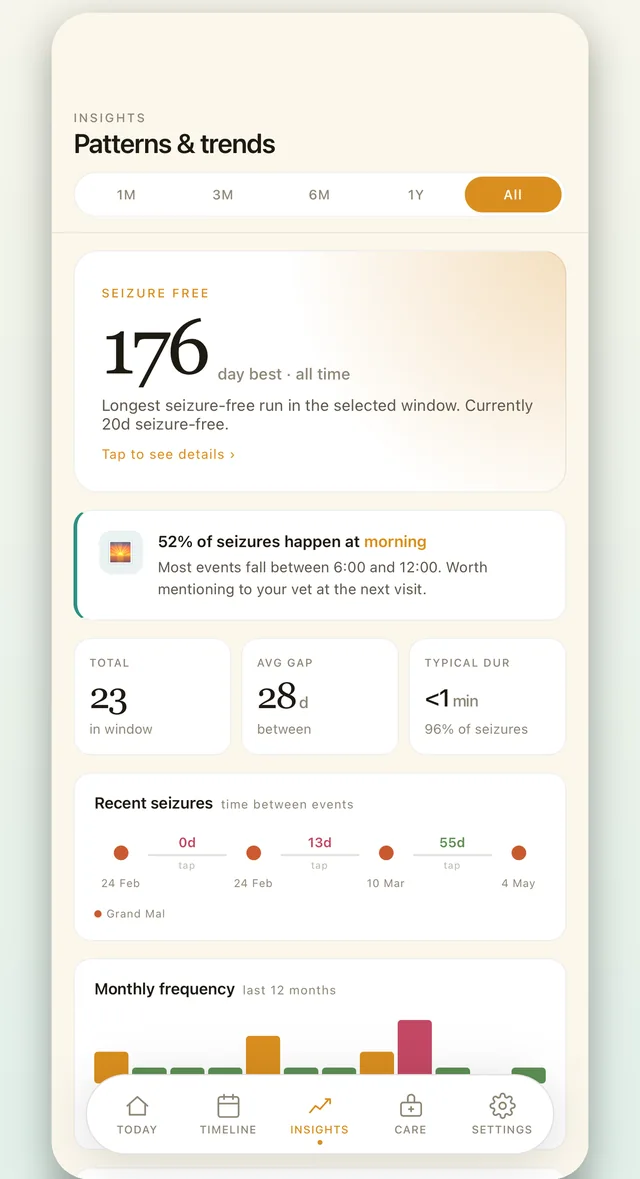
This is where a dedicated tracker earns its keep: instead of you poring over notes, it surfaces the patterns for you — like noticing that most events happen in the morning, or after a gap in medication. EpiPaws does this automatically in its insights view.
Spot the patterns you'd miss on paper
EpiPaws is free on iPhone — log seizures in seconds, track triggers and medication, and let it surface the trends. Works for cats too.
Download EpiPaws — freeFrequently asked questions
Do most dog seizures have a trigger?
No — most have no identifiable trigger and happen while the dog is resting or asleep. Triggers exist for some dogs, but you can't assume there is one.
Can stress cause a seizure in a dog?
Stress, excitement and anxiety are among the most commonly reported triggers, though they don't affect every dog. Logging helps you tell whether your own dog is sensitive to it.
Can I prevent my dog's seizures by avoiding triggers?
Avoiding a known trigger may reduce frequency for some dogs, but since most seizures have no trigger, trigger-avoidance is not a substitute for the medication and plan your vet prescribes.
How do I find out what triggers my dog's seizures?
Log every seizure with what happened in the day or two before, stay consistent for several weeks, then look for repeats. A tracking app can surface these patterns automatically. If you're choosing one, see our comparison of the best dog seizure tracker apps.