Dog Epilepsy Medication: Phenobarbital & Bromide
The two long-established medications for dog epilepsy are phenobarbital and potassium bromide, with imepitoin (Pexion) and add-ons such as levetiracetam now common too. They don't cure epilepsy — the goal is to make seizures less frequent and less severe. Phenobarbital boosts the brain's calming GABA signals; bromide makes nerve cells harder to over-fire. Both rely on steady blood levels, so the most important things you can do are give every dose on time and never stop suddenly — abrupt withdrawal can trigger life-threatening seizures.
When seizures need daily medication
Not every dog that has a seizure goes straight onto lifelong medication. Following International Veterinary Epilepsy Task Force guidance, vets generally suggest starting daily anti-seizure medication when a dog has had two or more seizures within six months, has had cluster seizures (more than one in 24 hours) or a single very long seizure, or has especially severe or prolonged recoveries afterward.
It helps to be clear about the goal from the outset. Medication doesn't cure epilepsy and rarely stops every seizure forever. Success is usually defined as cutting seizure frequency and severity by at least half. Many dogs do considerably better than that, but framing it this way saves a lot of heartache — an occasional breakthrough seizure doesn't mean treatment has failed.
Phenobarbital: the long-standing first choice
Phenobarbital has been used for dog epilepsy for decades and still has some of the strongest evidence of any seizure drug. Across studies it meaningfully reduces seizures in roughly 60–90% of dogs once the dose is dialled in. It's inexpensive and given as a tablet twice a day, about 12 hours apart.
How it works
Phenobarbital enhances the effect of GABA, the brain's main "calming" neurotransmitter. By strengthening that inhibitory signal, it makes neurons less likely to fire the runaway electrical storm that becomes a seizure.
Side effects to expect
For the first week or two many dogs are drowsy and a little wobbly; this usually fades as they adjust. More persistent are increased thirst, appetite and urination — normal, but worth knowing about. The serious concern is the liver: long-term use, especially at higher blood levels, can stress or damage it. Rarely, phenobarbital affects blood-cell counts.
Why the blood tests matter
Because the safe and effective window is fairly narrow, vets use therapeutic drug monitoring — a simple blood test that measures the phenobarbital level (commonly aimed at roughly 15–35 µg/mL, often the middle of that range) along with liver values. A typical schedule checks levels a couple of weeks after starting, again a few weeks later, then about every six months. These tests are how your vet keeps the dose high enough to work but low enough to stay safe.
Potassium bromide: the classic partner drug
Potassium bromide (you'll see it written as KBr, or as brands like K-BroVet) is the other long-established option. It's often added to phenobarbital when seizures aren't fully controlled, or used on its own when phenobarbital isn't ideal — for example in a dog with existing liver concerns, since bromide isn't processed by the liver.
How it works
Bromide ions take the place of chloride ions in nerve cells, making them harder to over-excite and raising the threshold at which a seizure can start.
It works slowly
Bromide builds up very gradually — it can take weeks to a few months to reach a fully effective level. To shorten that wait, vets sometimes prescribe a higher "loading dose" over a few days. Give it with food, as it can upset the stomach.
The diet catch most owners miss
Because bromide behaves like a salt, the amount of salt (chloride) in your dog's diet changes how much bromide stays in the blood. More salt lowers the bromide level (risking breakthrough seizures); less salt raises it (risking toxicity, known as bromism). So keep the diet consistent and check with your vet before switching foods or adding salty treats. Other side effects mirror phenobarbital's — sedation, wobbliness, increased thirst and appetite — plus occasional vomiting and, rarely, pancreatitis.
The main options side by side
Beyond the two classics, imepitoin (Pexion) is now considered a first-line option in many countries, and levetiracetam (Keppra) and zonisamide are widely used as add-ons. Here's how the common choices compare.
| Medication | Typically used as | What owners should know |
|---|---|---|
| Phenobarbital | First-line | Strong track record; twice daily; needs periodic blood and liver tests. |
| Potassium bromide | First-line or add-on | Easier on the liver; very slow to take effect; sensitive to dietary salt. |
| Imepitoin (Pexion) | First-line (where available) | Often fewer side effects and no routine blood-level checks; not right for every case. |
| Levetiracetam (Keppra) | Add-on | Well tolerated; usually dosed three times a day; popular as a top-up drug. |
Which combination is right is a decision for you and your vet — it depends on your dog's age, other conditions, seizure pattern and how well they tolerate each drug.
Why a missed dose matters so much
Anti-seizure drugs only work while they're held at a steady level in the blood, around the clock. Let that level dip and a seizure can slip through. That's why these medicines are given on a strict clock — and why a forgotten dose is more than a minor slip.
If you do miss one, the general rule is to give it as soon as you remember — unless it's nearly time for the next dose, in which case skip the missed one and carry on. Never double up to "catch up." Always follow the instructions on your dog's prescription label and your vet's advice, since the right move depends on the drug and how late you are.
Stopping phenobarbital (or any seizure medication) abruptly can trigger severe, back-to-back seizures — a state called status epilepticus that is life-threatening. Any change to the medication must be a slow, vet-supervised taper, never a cold stop.
Treat these as emergencies and get to a vet straight away: a seizure lasting more than 5 minutes, or more than one seizure in 24 hours.
How to give epilepsy medication consistently
Consistency is the whole game. A few simple habits make it far easier to never miss a dose:
- Pick two fixed times about 12 hours apart (say 8am and 8pm) and keep to them every day.
- Set phone alarms or app reminders for each dose so it never slips your mind.
- Give bromide with food to settle the stomach, and keep meals and treats consistent.
- Never run out. Refill early and keep a few days' buffer — a missed dose because the bottle's empty is avoidable.
- Keep up the blood tests your vet schedules, even when your dog seems perfectly well.
- Log every dose and every seizure so you and your vet can see whether the current plan is working.
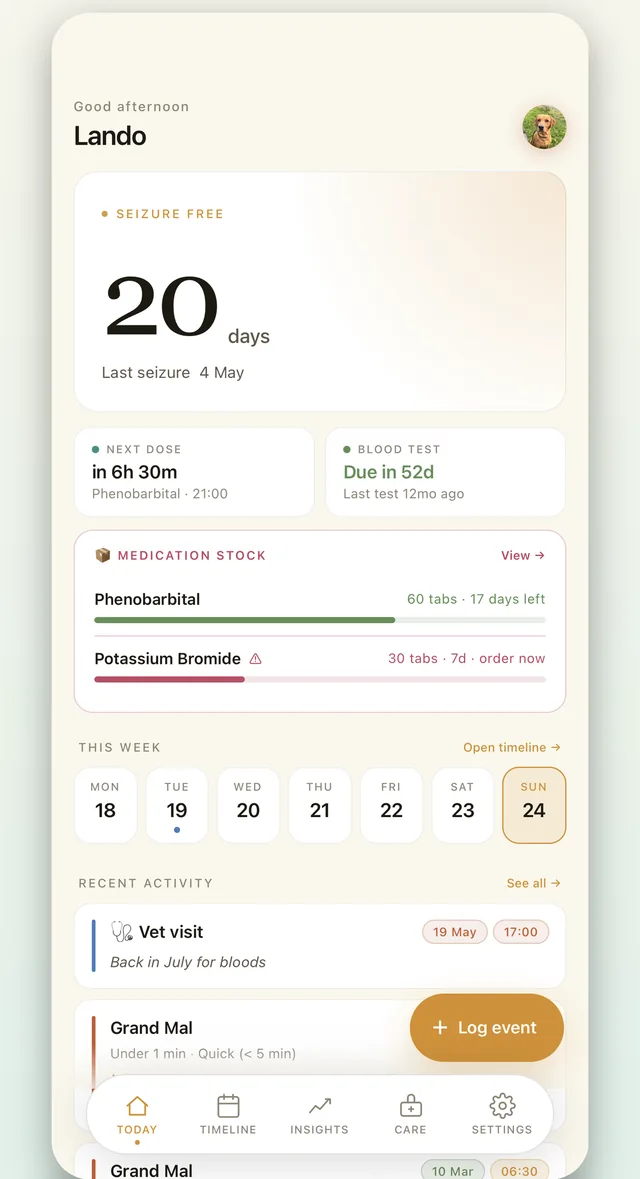
That last habit is where a tracker earns its keep. EpiPaws sends a reminder for each dose, tracks how much medication you have left so you reorder in time, and records the doses you've given — alongside any seizures — in one place.
Your log is how the dose gets adjusted
Your vet can't see what happens at home, so the record you keep is what guides every dose change. Bring a clear summary of seizure frequency, any breakthrough seizures, missed doses, and side effects to each visit. If you're not sure what to capture, our guide to tracking your dog's seizures for the vet walks through it — and it's worth noting that a missed dose is one of the most common seizure triggers.
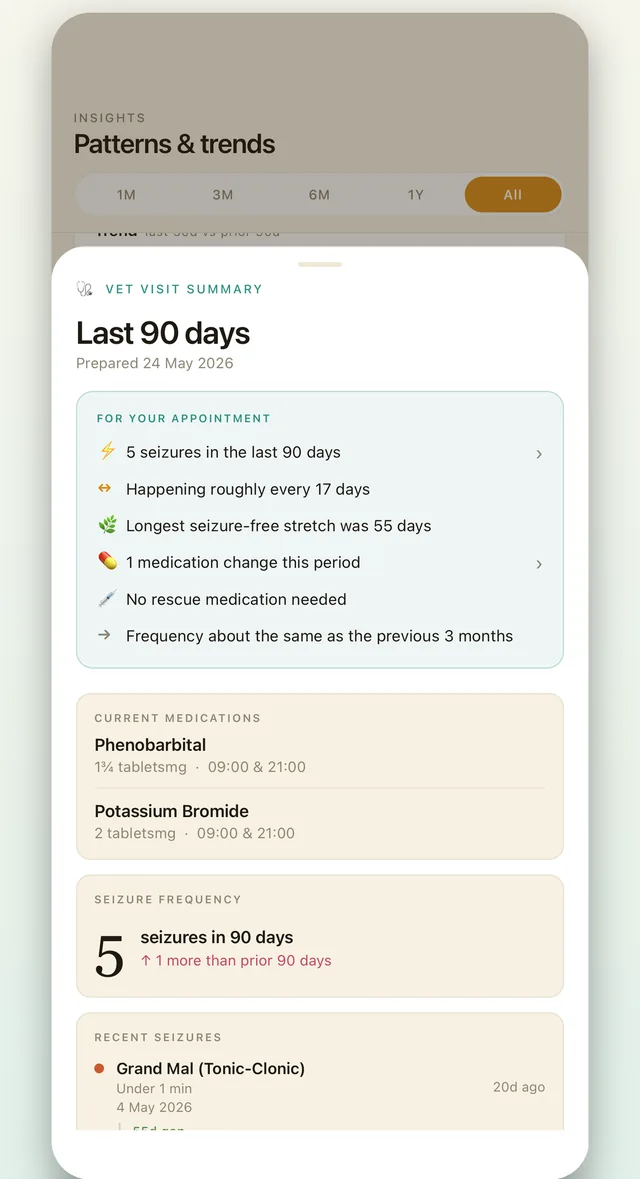
EpiPaws turns months of doses and events into a vet-ready summary — current medications and times, seizure frequency, and recent changes — in the format vets find easiest to act on.
Never miss a dose again
EpiPaws is free on iPhone — set medication reminders, track stock so you reorder in time, and share a vet-ready PDF at your next appointment. Works for cats too.
Download EpiPaws — freeFrequently asked questions
What is the best medication for dog epilepsy?
There's no single best drug. Phenobarbital and imepitoin (Pexion) have the strongest evidence as first-choice treatments, and potassium bromide is often added or used when phenobarbital isn't suitable. The right choice depends on your dog's age, other health conditions, seizure pattern, and how well they tolerate a drug — your vet will tailor it.
What are the side effects of phenobarbital in dogs?
In the first week or two many dogs are sleepy, wobbly, hungrier and thirstier; the drowsiness usually settles. Increased thirst, appetite and urination can persist. Long-term or high blood levels can affect the liver, which is why vets run periodic blood tests to keep the dose effective but safe.
What happens if my dog misses a dose of seizure medication?
Seizure medicines work by keeping a steady level in the blood, so a missed dose can let a breakthrough seizure through. As a general rule, give it when you remember unless it's nearly time for the next dose, in which case skip it — never double up. Follow your prescription label, and never stop the medication altogether without your vet.
Can a dog ever come off epilepsy medication?
Sometimes — a dog that has been seizure-free for a long stretch may be slowly weaned under veterinary supervision. But it's always done gradually over months. Stopping suddenly can cause severe withdrawal seizures, so never reduce or stop on your own.
How long does the medication take to work?
Phenobarbital reaches a stable level in the blood in about two weeks. Potassium bromide is much slower — weeks to a few months — so vets sometimes use a higher "loading" dose to reach effective levels faster. Blood tests confirm when the dose is right.