Cat seizures and feline epilepsy: a guide for owners
Seizures are less common in cats than in dogs, and more often have a cause that can be found. Here is what owners need to know, and what’s different from dogs.

Seizures are believed to be less common in cats than in dogs, and in cats they more often have an underlying cause, such as a toxin, illness elsewhere in the body or a problem in the brain. Any first seizure needs a call to your vet that day. A seizure lasting more than 5 minutes, or seizures one after another without recovery, is an emergency: call your vet now. Between visits, a log with video helps your vet find the cause and judge treatment.
- Only about a third of cats with recurrent seizures were classed as idiopathic epilepsy in pooled studies; most had a cause.
- Phenobarbital is the usual first choice in cats. Levetiracetam is increasingly used; evidence for zonisamide in cats is limited.
- Potassium bromide isn’t recommended for cats, and repeated oral diazepam has been linked to fatal liver failure in cats.
- Older cats can have reflex seizures set off by high-pitched sounds such as crinkling foil.
- Dog flea spot-ons containing permethrin can poison cats and cause seizures.
In this guide
Are seizures common in cats?
Less common than in dogs. International Cat Care says seizures in cats are believed to be less common than in dogs, and that primary (idiopathic) epilepsy is an uncommon cause. That’s why a seizing cat usually gets a thorough work-up rather than “wait and see”.
Seizure: a burst of abnormal electrical activity in the brain. Epilepsy: a tendency to have repeated seizures. Idiopathic epilepsy: epilepsy with no cause found, often presumed genetic.
What causes seizures in cats?
Vets group causes into three kinds:
- Reactive: the problem is outside the brain, such as a toxin, low blood sugar, or liver or kidney disease.
- Structural: something in the brain, such as inflammation, infection, a tumour or an injury.
- Idiopathic: no cause found.
A review by Pakozdy et al., 2014 pooled three larger studies: 77 of 233 cats (33%) were classed as idiopathic epilepsy. The same review notes that a considerable proportion of cats with recurrent seizures have no underlying disease, so idiopathic epilepsy does happen in cats.
Some spot-on flea treatments for dogs contain permethrin, which affects a cat’s nervous system and can cause twitching, tremors and seizures (International Cat Care). Never use a dog product on a cat. If it has happened, call your vet now.
What does a seizure look like in a cat?
It can be dramatic or subtle. In a generalised seizure a cat collapses, loses awareness, and may paddle or stiffen, drool, and lose control of the bladder or bowels. Smaller (focal) seizures can look like twitching of the face, drooling, odd vocalising or strange behaviour, and are easy to miss or mistake for something else. Fainting from heart disease can look similar, which is one reason video helps.
Reflex seizures in older cats
Some older cats have seizures set off by particular sounds. In a study of 96 cats with feline audiogenic reflex seizures (FARS), the median age at onset was 15. The most common triggers were crinkling tin foil and a metal spoon dropped into a ceramic food bowl. Most were brief jerks (myoclonic seizures), Birmans were over-represented, and half the cats had poor hearing or deafness. A later trial found levetiracetam worked better than phenobarbital for these cats. See International Cat Care’s FARS page.
What should I do if my cat has a seizure?
- Stay calm and note the time.
- Move things away so your cat can’t fall or hit anything; don’t pick them up mid-seizure.
- Keep your hands away from their mouth, and don’t restrain them.
- Dim the lights, keep it quiet, and film from a distance if you can.
- Afterwards, let them recover somewhere quiet and safe.
Our seizure first-aid guide is written for dogs, but the safety steps are the same.
A seizure lasting more than 5 minutes, or seizures one after another without your pet recovering in between, is an emergency. Call your vet or the nearest emergency clinic now and tell them you're on your way. A first-ever seizure also needs a call to your vet the same day, even if your pet seems fine afterwards.
The 2024 ACVIM consensus statement on status epilepticus and cluster seizures covers cats as well as dogs and uses the same 5-minute definition.
How is epilepsy in cats different from dogs?
| Topic | Dogs | Cats |
|---|---|---|
| How common | Fairly common | Believed to be less common |
| Usual cause | Idiopathic epilepsy is a frequent diagnosis | More often a cause is found |
| First-choice medicine | Phenobarbital or imepitoin | Phenobarbital; levetiracetam increasingly used |
| Potassium bromide | Used as an add-on or first choice | Not recommended: risk of serious lung disease |
| Diazepam | Rectal diazepam is one rescue option (ACVIM) | Repeated oral doses linked to fatal liver failure |
Sources: MSD (Merck) Veterinary Manual for medicines, which notes the “lack of clinical evidence” for zonisamide in cats; Center et al. (1996), in which 10 of 11 cats with liver failure after repeated oral diazepam died or were euthanised.
Never give a cat a medicine prescribed for a dog or a person. Doses and safety differ between species, and some drugs that suit dogs are dangerous for cats.
How do vets find out why a cat is having seizures?
Expect a full physical and neurological examination and blood and urine tests, and often a blood pressure check. If the cause isn’t clear, your vet may suggest an MRI or CT scan, sometimes with spinal fluid tests. Treatment is usually aimed at any cause found, plus anti-seizure medicine when seizures are frequent, clustered or severe. Medicine is usually long-term and must never be stopped suddenly.
How do I track my cat’s seizures?
Cats hide illness and often seize when nobody is watching, so a record matters even more. For each episode, note:
- the date, time and how long it lasted
- what it looked like, and a video if possible
- anything beforehand, including sounds, stress or new products in the home
- how recovery went and how long it took
- medicine given, and any missed doses
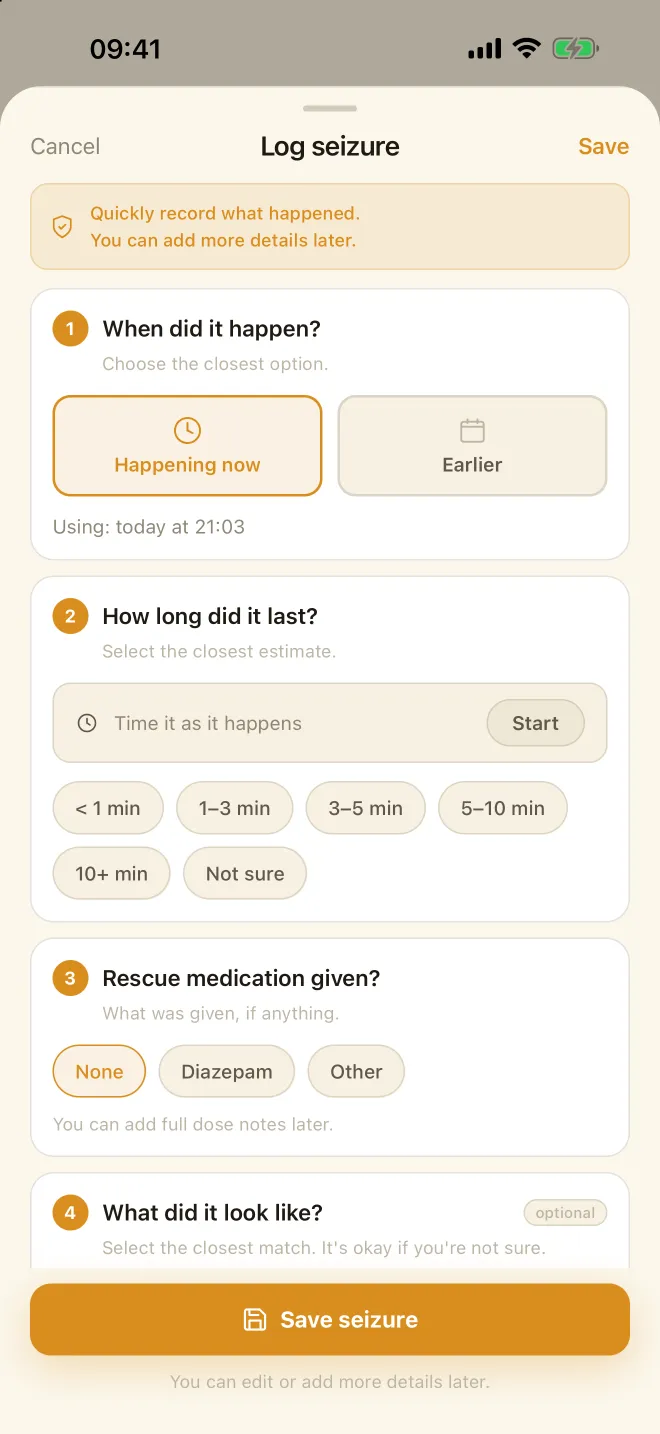
Our guide to tracking seizures for the vet is written for dogs but works just as well for cats.
Frequently asked questions
Are seizures common in cats?
What causes seizures in cats?
What should I do if my cat has a seizure?
What medicines are used for epilepsy in cats?
Can I give my cat my dog’s seizure medicine?
Can I use EpiPaws for my cat?
Written by Jake Wise. I make EpiPaws and live with Lando, a Labrador with idiopathic epilepsy. I'm not a vet: this guide summarises published veterinary sources, which are linked inline and listed below. If you spot a mistake, email jake@rockethound.io.
Not veterinary advice. This is general information to help you talk to your vet. It can't diagnose your pet or tell you what dose to give. If a seizure lasts more than 5 minutes, or seizures come one after another without recovery in between, it's an emergency: call your vet or the nearest emergency clinic now.
Sources
- International Cat Care. Seizures in cats. icatcare.org
- Pakozdy A, Halasz P, Klang A. Epilepsy in cats: theory and practice. Journal of Veterinary Internal Medicine, 2014;28(2):255–263. pmc.ncbi.nlm.nih.gov
- Castel A. Anticonvulsants for Treatment of Animals. MSD Veterinary Manual (Merck Veterinary Manual in the US), reviewed 2025. www.msdvetmanual.com
- Center SA, et al. Fulminant hepatic failure associated with oral administration of diazepam in 11 cats. JAVMA, 1996;209(3):618–625. pubmed.ncbi.nlm.nih.gov
- Lowrie M, Bessant C, Harvey RJ, Sparkes A, Garosi L. Audiogenic reflex seizures in cats. Journal of Feline Medicine and Surgery, 2016;18(4):328–336. pmc.ncbi.nlm.nih.gov
- Lowrie M, et al. Levetiracetam in the management of feline audiogenic reflex seizures: a randomised, controlled, open-label study. Journal of Feline Medicine and Surgery, 2017;19(2):200–206. pmc.ncbi.nlm.nih.gov
- International Cat Care. Feline audiogenic reflex seizures (FARS). icatcare.org
- International Cat Care. Permethrin poisoning. icatcare.org
- Charalambous M, et al. ACVIM Consensus Statement on the management of status epilepticus and cluster seizures in dogs and cats. Journal of Veterinary Internal Medicine, 2024;38(1):19–40. pmc.ncbi.nlm.nih.gov
Keep reading
What to do when your dog has a seizure
Keep them safe, time it, hands away from the mouth, and the 5-minute rule that tells you when to call. The guide to read before you need it.
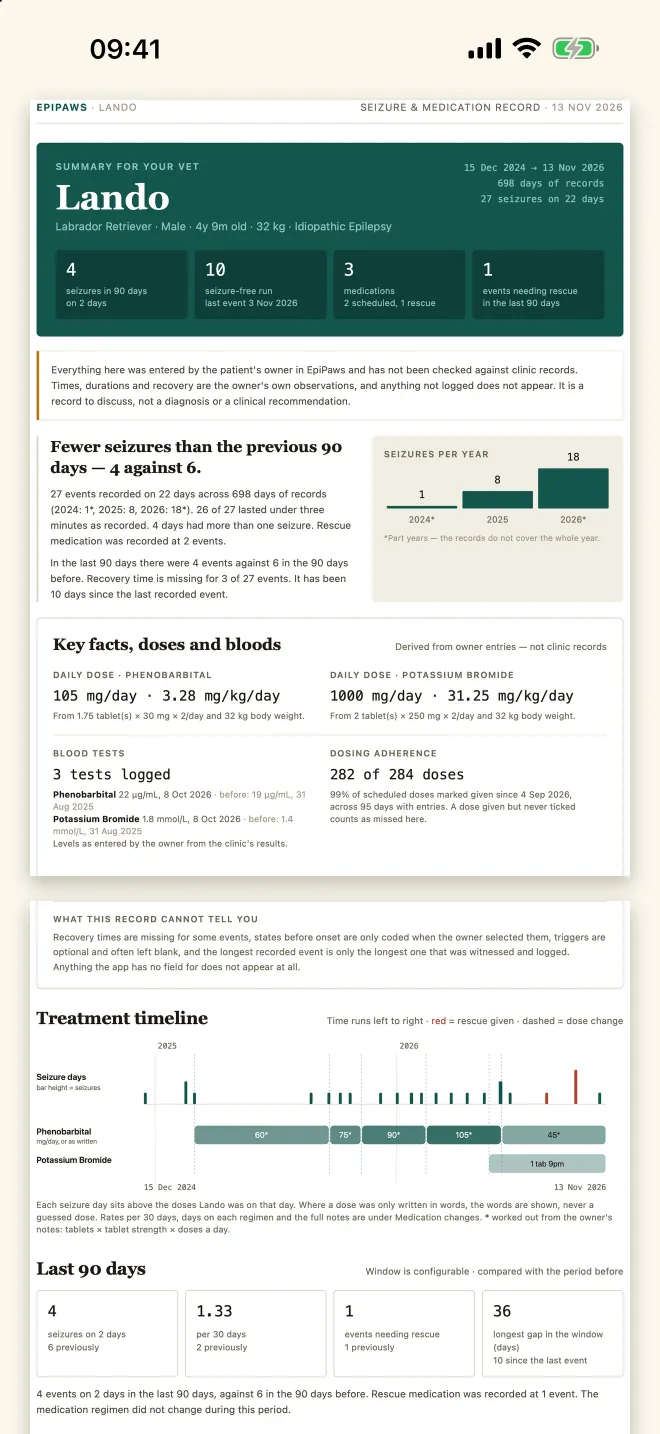
How to track your dog’s seizures for the vet
The checklist for every seizure, why the dates matter so much, and how to hand your vet the whole story on one page.
Dog epilepsy medication: phenobarbital, bromide and the rest
Phenobarbital, imepitoin, potassium bromide and levetiracetam explained, plus why blood tests matter and why you never stop suddenly.